Calm tech design has, for decades, carried a quiet promise: that good design could step back, breathe, and let people live. But something has shifted. And if you work with materials, surfaces, and human interaction — the way I do — that shift matters deeply.
The original idea was elegant in its honesty. Coined at Xerox PARC in the mid-1990s by researchers Mark Weiser and John Seely Brown, it described technology that informs without demanding attention — systems that live at the periphery of awareness rather than screaming at the center of it.
As Hackaday’s thoughtful breakdown of the philosophy puts it, the foundational principles are almost disarmingly simple: technology should require the smallest possible amount of attention, should work even when it fails, and — crucially — should use only the minimum needed to solve the problem. A well-designed object that fades into your routine. A device that does its job without making you feel like the product. That was the vision. And for a while, it held.
Then Big Tech discovered the aesthetic.

Calm Tech Design and the Beautifully Finished Smokescreen
Look at what’s hit the market over the past couple of years. Timber smart-home status boards. AI-enabled journals wrapped in linen covers. “Dumbphones” with rounded corners and muted palettes. Lapel badges. AI compasses. Even the Meta Ray-Ban smart glasses — surveillance hardware dressed up in lifestyle clothing. Each of these products wraps itself in the visual language of calm tech design: warm materials, soft radii, hidden displays, analogue textures.
Each of them whispers “trust me, I’m simple.” And yet, underneath that surface, the business models are anything but quiet. They harvest attention. They gather data. They lock users into ecosystems built on exactly the kind of anxiety they claim to resolve.
This is the core contradiction shaping the current moment in product design. The vocabulary of calm — natural wood, textile softness, screen-free forms — has been lifted from its ethical roots and repurposed as marketing camouflage. As a result, calm tech design is no longer just a philosophy. It’s a battleground.
What “Calm Tech Design” Was Always Supposed to Mean
To understand why this matters, it helps to return to the source. Calm tech design was never simply about aesthetics. It was about cognitive load, about peripheral awareness, about the profound respect for a user’s attention as a finite and precious resource. The Hackaday analysis captures this well, noting that studies suggest it takes roughly 23 minutes to regain focus after an interruption — meaning that every unnecessary notification, every redundant interaction demand, every cloud-dependent device that turns into a brick when the server goes down is, in effect, stealing time from real human life.
Meanwhile, the design world has not been blind to the opportunity. As early as 2022, Deutsche Telekom Design & Customer Experience and strategic design agency Layer unveiled their Connectivity Concept at Salone del Mobile — a line of routers, set-top boxes, and mesh repeaters characterised by pared-down lines, natural wood accents, mirror-polished finishes that conceal interfaces when switched off, and cables routed out of sight. On/off buttons hidden at the back. A gentle luminescence indicating activation. It was, in visual terms, a masterclass in calm tech design.
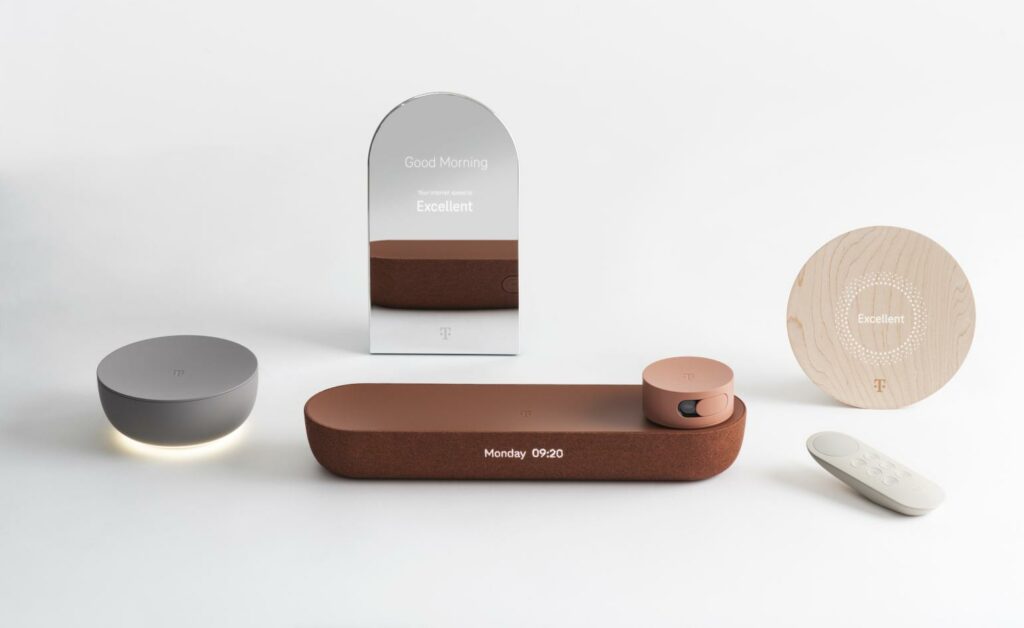
And yet the deeper question — what does the product do with your data? what happens when the network goes down? can you repair it? — remained largely unasked and unanswered. Beautiful objects do not automatically make honest systems. That gap — between looking calm and being calm — is precisely where the design conversation needs to move.
Why Wood Alone Cannot Save Calm Tech Design
Natural materials have long been understood as powerful signals of calm. Wood, in particular, carries associations of warmth, craftsmanship, low environmental impact, and human scale — all qualities that calm tech design has historically tried to embody. Research and design writing from perspectives across the global design industry have pointed to wood’s role in softening the hard edges of technology, making devices feel like they belong in a home rather than in a server farm.
And the woodworking and furniture manufacturing community has long argued that wood-integrated smart home products represent one of the most promising intersections of material craft and technology — provided, of course, that the two are genuinely in dialogue.
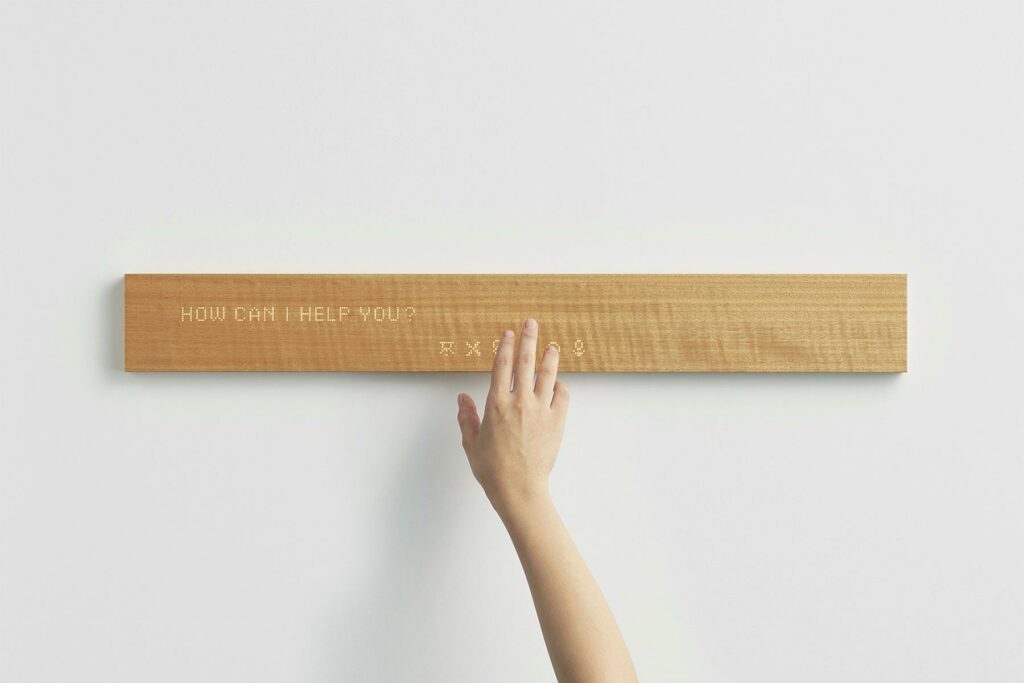
The problem is that warm walnut and sustainably-sourced timber have become shorthand for trustworthiness in tech, and shorthand, in the hands of marketing departments, quickly becomes a cliché. When a product uses wood veneer to signal low impact while simultaneously running continuous background data collection, the material is no longer an expression of values — it is a costume. The surface and the soul of the product have come apart.
The Differentiation Opportunity Hidden in the Critique
Here, though, is where the conversation gets genuinely interesting. Because where there is widespread fakery, there is always space for the real thing.
The current wave of aestheticized calm has inadvertently opened a differentiation lane for designers who are willing to go further — not just to look honest, but to be verifiably so. Consider what that actually means in practice. The Hackaday analysis offers a precise and practical test: can the device be operated manually, without an app, without network access?
Does it continue to function when it fails? Does it respect social norms — meaning, would using it in the presence of others feel strange or invasive?
If a smart-home device can only be controlled through a proprietary app that requires a cloud subscription, it has already failed the most basic calm technology test, regardless of how much reclaimed oak it wears.
This is what genuine calm tech design looks like in 2026: local data processing rather than cloud dependency, minimal sensor arrays that collect only what they need, clear data states — visual or tactile cues that tell users honestly what the product knows and what it is doing — repairable enclosures with visible assembly logic, and material choices that reflect real environmental accounting rather than nature-coded signals.
The Deutsche Telekom and Layer Connectivity Concept pointed in the right direction aesthetically. The next step is to point just as deliberately in the right direction structurally — to design the architecture of restraint first, and then let the warm wood speak truthfully about it.
Calm Tech Design Turns CMF Into an Ethical Statement
For those of us who work at the intersection of materials and meaning, this reframing is both a challenge and an invitation. Choosing a warm wood veneer is no longer simply a CMF decision — it now carries an implicit claim. It says: this product is trustworthy. It says: this product is low impact. It says: this product respects you. If the product doesn’t live up to that claim, the material becomes a lie. And users — increasingly media-literate, increasingly skeptical of tech promises — are starting to notice the difference between a lie and a truth, even when both look beautiful.
That means the next wave of calm tech design must be built from the inside out. It starts with the data architecture, the energy budget, the repairability plan. Then it reaches outward through the interaction logic, the UX states, and finally — finally — the surface. The material should be the last layer of the story, not the first. When it works in that order, calm tech design becomes something powerful: a product that earns what it looks like.
Designing With Accountability, Not Just Aesthetics
The designers who will matter most in the next decade are those who understand that calm is not a color palette. It is not a texture. It is not even a UX principle, taken alone. As the founding principles remind us, the right amount of technology is the minimum needed to solve the problem — and that minimum should never demand more from a user than the task requires.
Calm is a relationship between a product and its user, built on honesty about what the product takes, what it gives, and what it costs. That relationship can absolutely be expressed through beautiful materials and considered forms. But it has to exist first in the engineering brief, in the business model, in the data policy.
This is also, ultimately, why the current wave of fake-calm products will not age well. Because calm, in its truest sense, is about trust. And trust, once broken by a beautiful object, is very hard to rebuild.
See This Thinking Applied in Practice
If the question of how material choices carry ethical weight resonates with you, I’d invite you to explore my portfolio. Across furniture, industrial, and product design projects, I’ve consistently worked to align the visible surface of a design — its CMF, its assembly logic, its ergonomic language — with the structural and functional honesty beneath it.
That approach didn’t start with a trend brief. It comes from a background spanning CAD detailing for heavy steel structures, furniture development for mass production, and the kind of hands-on manufacturing experience that teaches you quickly: what something looks like and what it is are only the same thing when someone cares enough to make them match. You can read more about that background at my resume.
Sources referenced in this article: