Yamaha Sound Concepts: New Stunning Forms Born of Sound
Yamaha Sound Concepts stop you cold. Not because they are beautiful — though they are — but because they ask a question that most audio design has never dared to pose. What if a speaker were not a box? What if, instead, it were a sail, a wing, a crystal, a horn?
The Yamaha Design Laboratory in Japan has answered that question with four experimental prototypes that redefine the relationship between sound, form, and the human body. These are not incremental refinements. They are, above all, declarations.
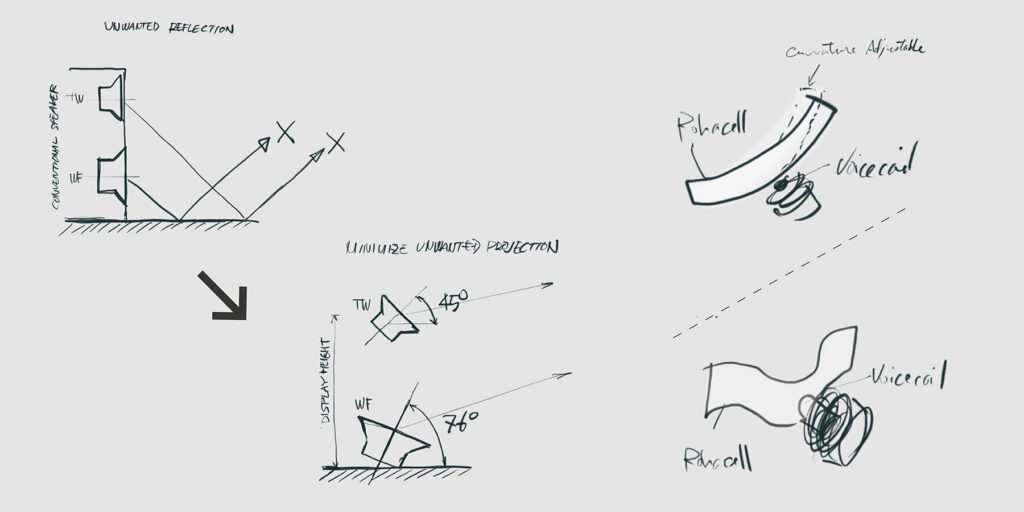
Each of the four Yamaha Sound Concepts begins with the same radical starting point: the problem of unwanted surface reflections. In most home audio setups, sound bounces off tabletops and nearby surfaces, coloring the output and reducing clarity. Rather than solving that problem through electronics, Yamaha’s designers solved it through geometry.
They let the acoustic challenge grow outward until it became a shape — and in doing so, they crossed the boundary between engineering and art.
The Sail: A Diaphragm Set Free
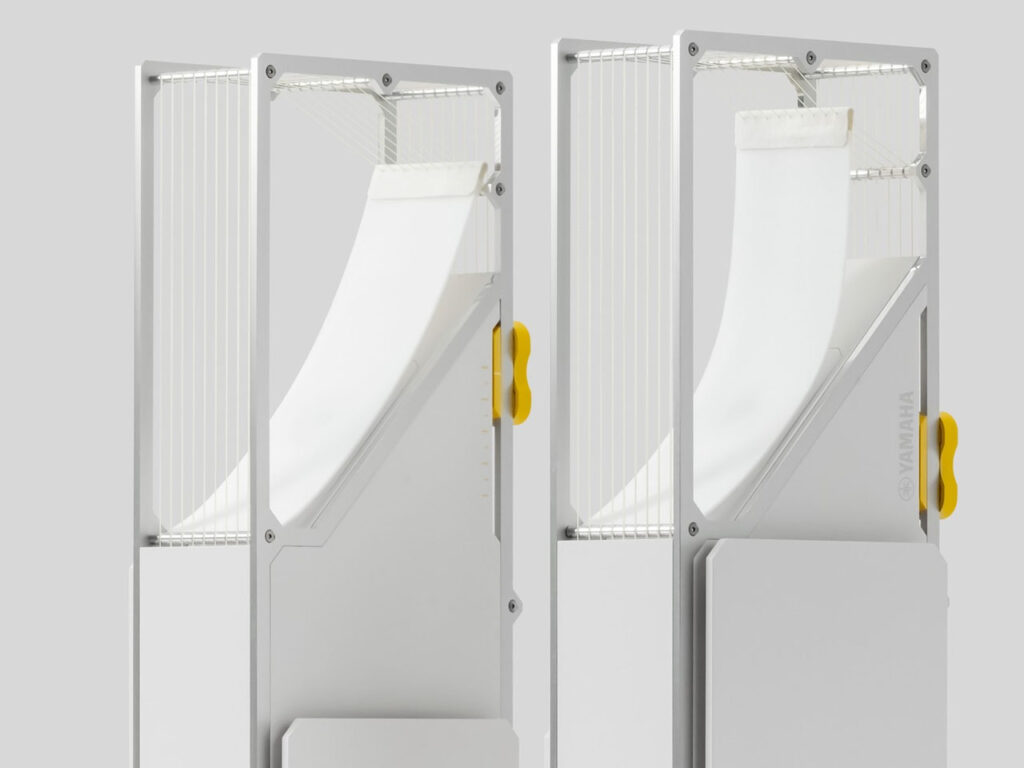
The first of the Yamaha Sound Concepts is the Sail. Stand before it and let it settle into your eyes. What you see is tension. A diaphragm hangs between stretched strings, suspended like a canvas mid-flight, like a mainsail catching invisible wind. It is, indeed, deeply moving.
The material is ROHACELL — a closed-cell rigid foam of extraordinary lightness and stiffness. It vibrates cleanly and holds its shape under heat. Furthermore, it carries sound with an honesty that denser materials simply cannot match. However, the material is only half the story. The user adjusts the sail physically, shifting its tension and angle. Consequently, the sound changes in response. Listening becomes participatory. The speaker becomes, in effect, a tunable instrument.
This resonates directly with my own design philosophy. In pieces like the KrossBand Cabinet and the KrossDraw Cabinet, structural tension creates meaning. A floating top suspended above a grounded volume generates a spatial dialogue — where mass resides and where lightness breathes. Form, in both cases, is not decoration. It is reasoning made visible.
The Butterfly: Symmetry That Breathes
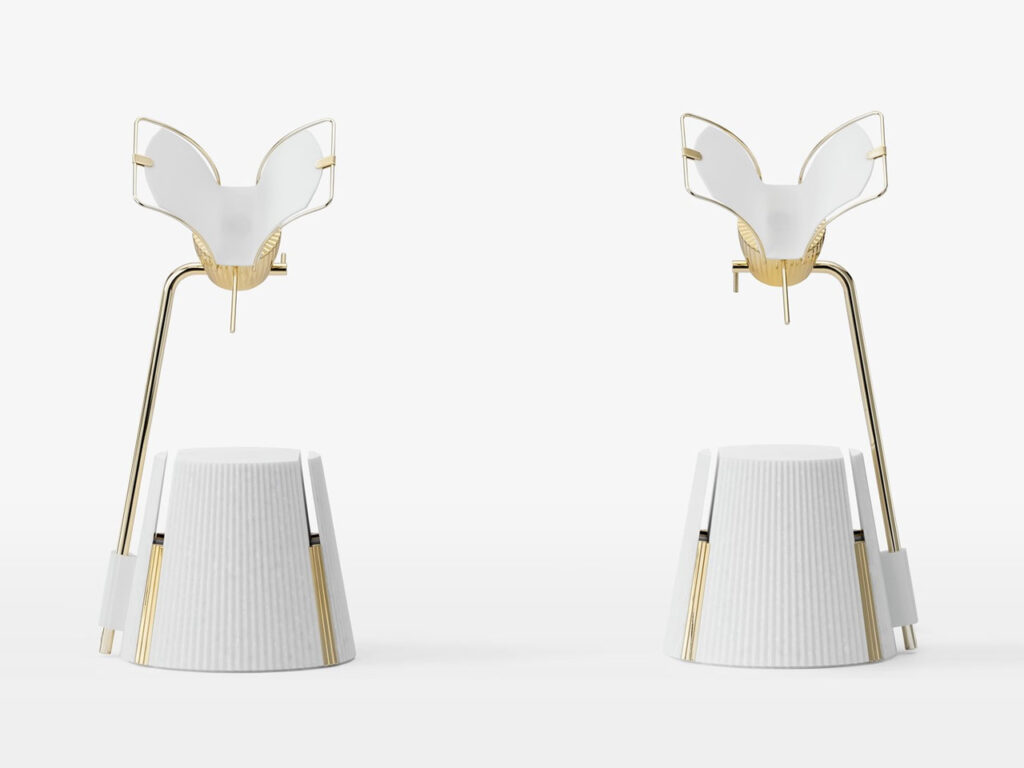
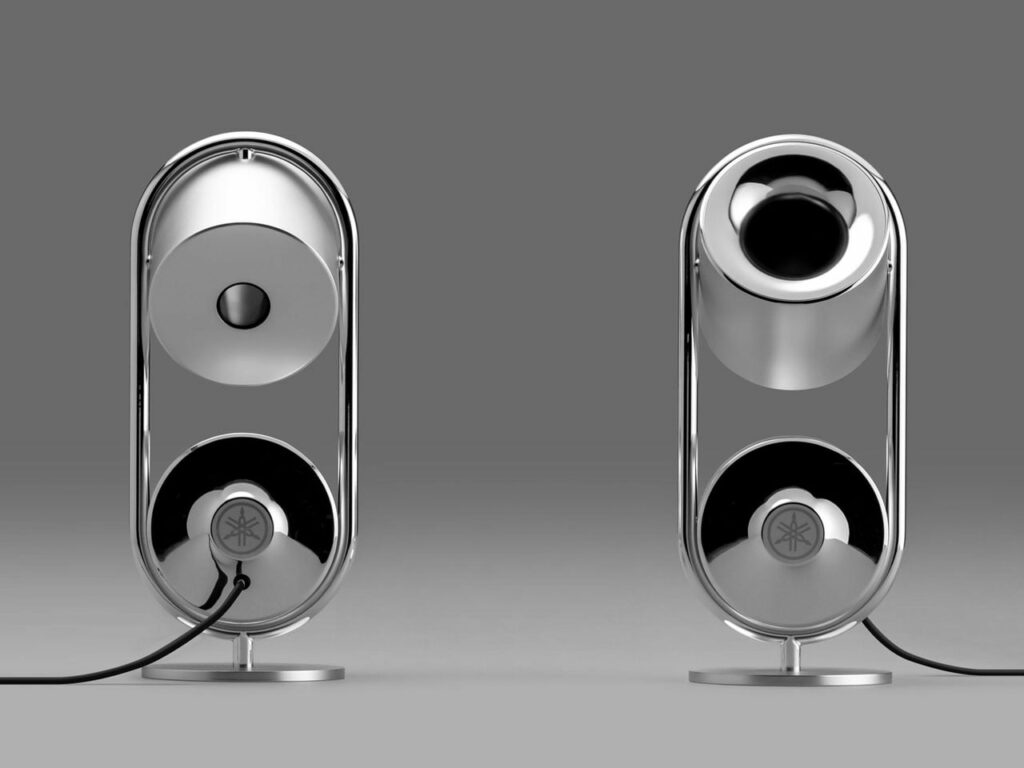
The second of the Yamaha Sound Concepts, the Butterfly, draws from nature’s oldest design logic: bilateral symmetry. Two driver units sit back-to-back, separated by a reflective surface, with the top left deliberately open and unenclosed. As a result, sound disperses freely — filling the room from the inside out rather than projecting forward like a pointed finger.
Moreover, the listener can adjust the volume relationship between the internal and external chambers, shifting the spatial character of the audio in real time. The room itself, in turn, becomes part of the instrument. What strikes me most, however, is the courage of restraint here. The Butterfly does not attempt to control everything. It releases. It trusts the space.
This is equally the instinct behind my Pytho Midtable — where stacked, offset surfaces in walnut and white create movement not through complexity but through deliberate omission. The empty space between layers is precisely where the design breathes.
Horn and Cristal: Sound as Apparition
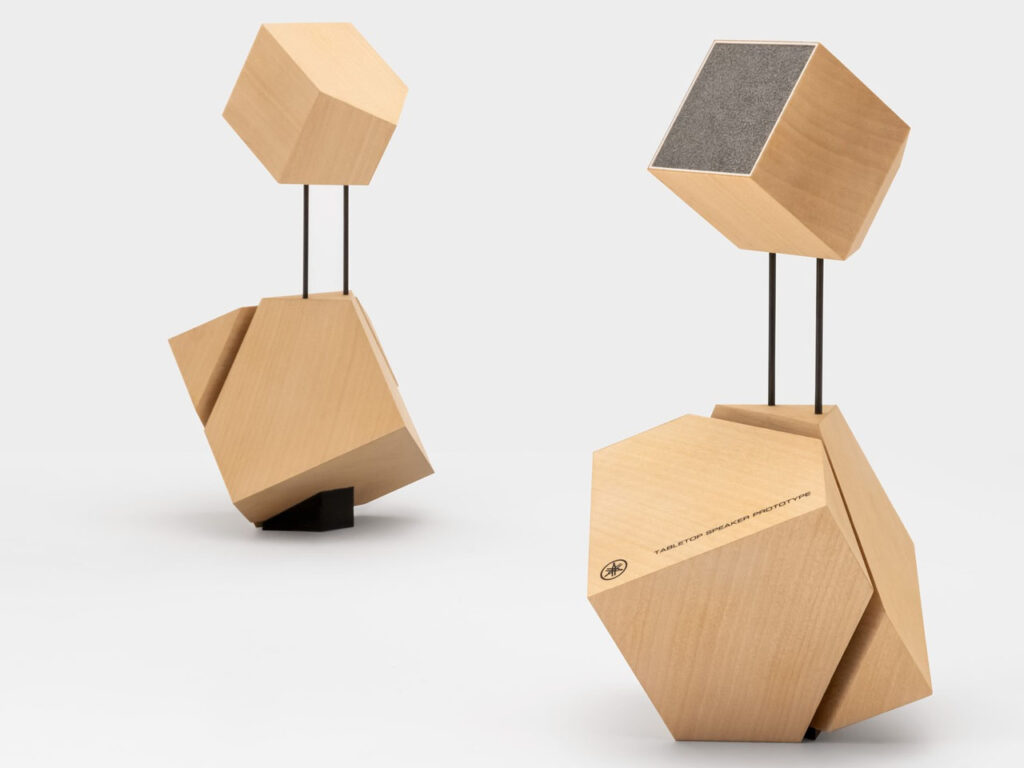
The remaining two Yamaha Sound Concepts push the exploration further still. The Horn channels audio along a shaped enclosure, much the way a brass instrument channels breath into vibration. Place the driver partway along the horn. Let the form guide what follows. At times, the effect borders on the uncanny — sound seems to emerge not from an object but from open air itself. It is, without question, the acoustic equivalent of a conjuring trick.
In contrast, the Cristal takes the opposite road entirely. Strip everything back. Opposing drivers, open at the top, pure minimal geometry. The form recalls a perched bird or a faceted gemstone caught in cool light. Reflections manage themselves through shape alone. Nothing is hidden. Everything is resolved. Together, these two Yamaha Sound Concepts prove the same thesis: the path sound takes outward matters as much as what generates it within.
I recognise this same thinking in my Dorm MidTable — the origami coffee table where every angle exists because the structure demanded it. Similarly, in the Brancher Cabinet, organic branching motifs suggest motion within a static form. Great design, in both cases, does not decorate a problem. It thinks through it until beauty appears on the other side.
What These Yamaha Sound Concepts Mean
These four Yamaha Sound Concepts do not exist merely to be purchased. They exist, above all, to ask something of us. They ask whether we are willing to rethink the relationship between an object and the room it inhabits — between a listener and the thing they listen through. Furthermore, they demonstrate that acoustic performance and artistic expression are not opposing values. They are, in fact, co-authors of the same idea.
Yamaha has always moved fluidly between engineering precision and artistic courage. From concert grand pianos to motorcycles, the brand treats its materials the way a composer treats a score — with discipline and with wonder. These Yamaha Sound Concepts carry that tradition powerfully forward. They are prototypes, yes. But they are also, ultimately, proposals — a vision of listening as a fully embodied, participatory act.
For any designer who believes that form and function are not opposites but partners, these Yamaha Sound Concepts offer something rare and genuinely inspiring. They offer proof.