Cliff hotel Greece rarely chooses restraint. Yet Olen, a seven-suite resort on the island of Syros, makes exactly that choice. And as a product designer and art critic, I find this immediately compelling.
Designed by Athens-based Ateno Architecture Studio, Olen sits on a wild, rugged stretch of Aegean coastline. Rather than imposing a bold structure on the land, the studio carved the resort directly into the cliffside. Consequently, the hotel does not sit on the landscape — it becomes part of it.
That decision alone separates Olen from nearly every other cliff hotel Greece has produced. Most developers see an untouched coastal site and build upward. Ateno Architecture Studio, however, built inward — into the rock itself.
Cliff Hotel Greece: Three Zones, One Spatial Argument
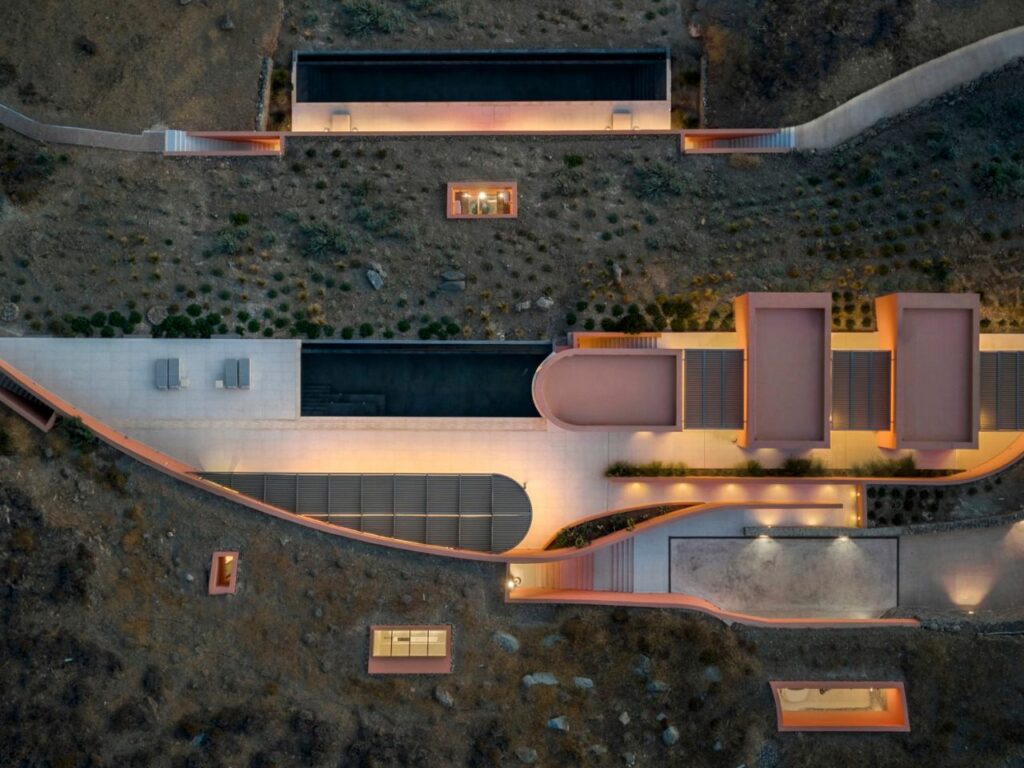
The design organises the cliff hotel Greece into three zones: The Plane, The Line, and The Point. Each one descends the cliff in an amphitheatre-like sequence. Together, they trace the terrain rather than fight it.
A winding path connects all three zones. As you move lower, the spaces grow progressively more private. In other words, the architecture follows the social logic of retreat — from communal to intimate — through pure spatial sequence.
This approach also borrows directly from the Greek landscape’s own grammar. The terraced hillside, the retaining wall, the sheltered alcove — these forms already existed here. Ateno Architecture Studio, therefore, did not invent a language; instead, they spoke the one the site already uses.
The Plane: Where the Cliff Hotel Opens to the Aegean
At the top of this cliff hotel Greece sits The Plane. Here, a curved retaining wall sweeps around a generous terrace. Meanwhile, a leaf-shaped pergola casts soft shade while the pool mirrors the open Aegean.
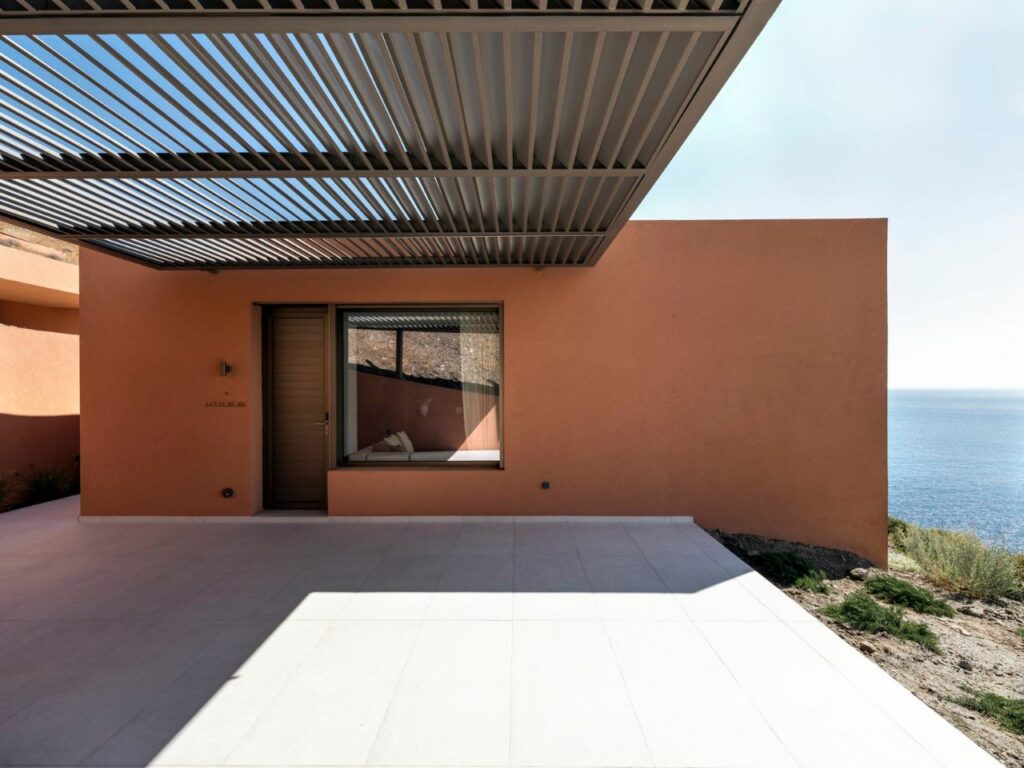
Beneath that terrace, one bedroom and shared living areas nestle quietly into the hillside. Furthermore, three cubic bedroom volumes extend outward from the slope. Each one frames the sea like a deliberate compositional lens.
This is where I recognise the core design argument. When the room itself becomes the viewing frame, the architecture openly admits its secondary role. As a result, the horizon wins, the cliff wins, and the hotel steps back.
Cliff Hotel Greece and the Philosophy of Greek Design
This cliff hotel in Greece also draws on a philosophy I know well as a Greek designer. The best designers — product designers, architects alike — share one belief: great design does not impose itself. Instead, it reveals what was always already there.
Sotiris Lazou, one of Greece’s most accomplished industrial designers, trained at Milan’s Domus Academy under Andrea Branzi and Ettore Sottsass. His work, similarly, centres on archetypal form and material honesty.
His Cosmos table — winner of the 2008 Good Design Award and held in the Chicago Athenaeum collection — is not invented. It is inevitable.
Ateno Architecture Studio applies that same logic at architectural scale. The cliff, the rock, the slope — these are not obstacles to work around. Rather, they are the design itself.
The Line: Underground Suites in This Cliff Hotel Greece
Further down the slope, The Line holds two underground suites. These can operate independently or, alternatively, combine into a single unit. Moreover, a long, narrow infinity pool stretches between them toward the sea.
That pool is not decorative. It is, in fact, structural reasoning made visible in water.
In this way, The Line turns what could have been a simple amenity into a clear architectural argument. As ArchDaily has shown in its research on contextual hospitality design, hotels that truly belong to their landscape generate far greater emotional value. Olen proves that point in concrete and water.
The Point: The Cliff Hotel’s Most Secluded Space
At the very base of the site, The Point offers the most secluded experience of this cliff hotel Greece. Here, too, a curved stone wall frames a private guesthouse. Additionally, a small circular pool draws attention inward rather than outward.
The material also shifts noticeably at this level. Exposed stone replaces the warm rendered surfaces used above. This, therefore, is an editorial decision — one that anchors the architecture to the raw geology beneath it.
As Dezeen notes in its coverage of the project, that textural contrast between stone and render is one of the most deliberate choices in the entire design. The architecture, in other words, confesses its origins.
Inside the Cliff Hotel Greece: Landscape Meets Room
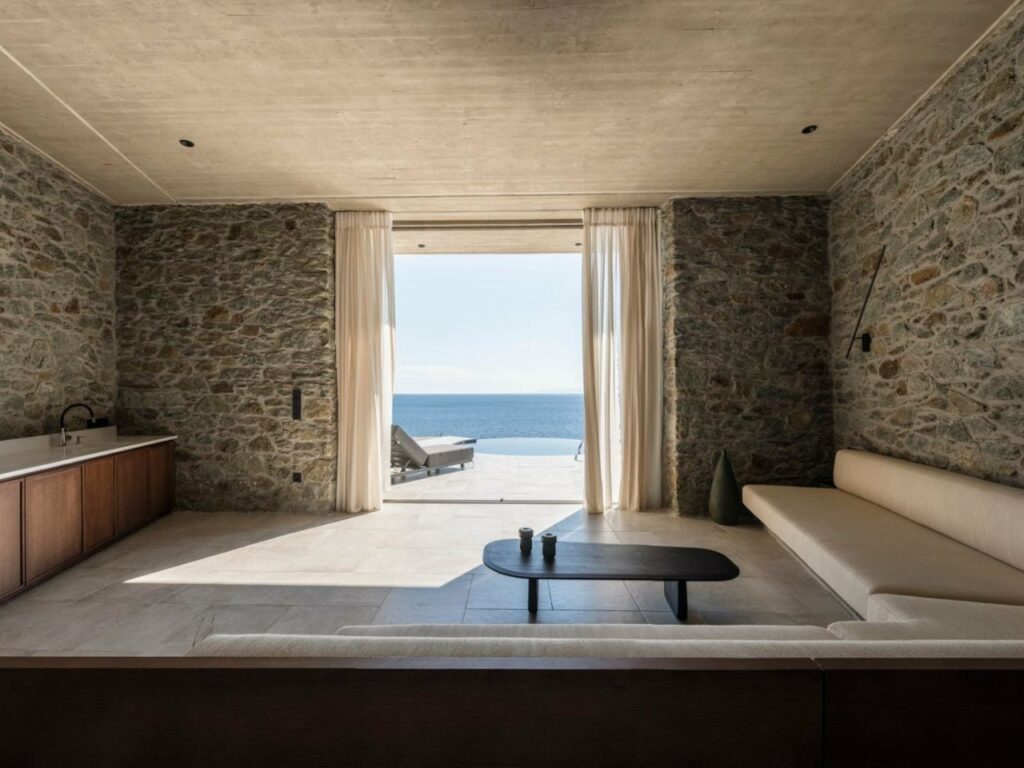
Inside the suites, the same discipline continues. Soft off-white tones reflect natural light throughout. Meanwhile, pale stone flooring connects interior surfaces directly to the terraces outside.
There is, consequently, no hard threshold between room and landscape. You move through a single continuous material field. In turn, the boundary between inside and outside simply dissolves.
That continuity is precisely what makes this cliff hotel Greece stand apart. It does not bring nature inside as a decorative gesture. Rather, it extends the interior outward — into nature — as a full sensory experience.
Why This Cliff Hotel Greece Is a Masterclass in Restraint
Ultimately, Olen makes one powerful design argument. Restraint is a form of ambition. Furthermore, not building a spectacle takes more courage than building one.
This cliff hotel on Syros succeeds because it refuses to perform. It simply exists — beautifully, quietly, inevitably. Above all, it belongs.
The best work always asks the same question. Not: how do I stand out? But: how do I belong? Olen, indeed, knows the answer.
More Design Thinking at Intellence
If this exploration of landscape-responsive design resonates with you, discover more design thinking at intellence.eu/news. There, I write about envelope-first product design, material logic, and the decisions that connect form to context — ideas that run directly parallel to what Ateno Architecture Studio achieves on the cliffs of Syros. You can also explore my professional background in industrial and furniture design at intellence.eu/resume, where a career spanning furniture series at IRVEN and the export practice connects to exactly these questions of restraint, material honesty, and belonging.