Studio GGSV does not decorate spaces.
Instead, they reimagine them entirely. Rather than asking how to furnish a room, they ask what it should feel like to think inside one. That single question drives this whole project. And it shows in every surface, every joint, every choice of wood. Above all, it shows in the way the three rooms make you feel.
Sofia Lekka Angelopoulou covered this project for Designboom in September 2025. Moreover, she visited the installation in person and spoke directly with the designers. As a result, her piece carries a sensory authority that no secondary report can match.
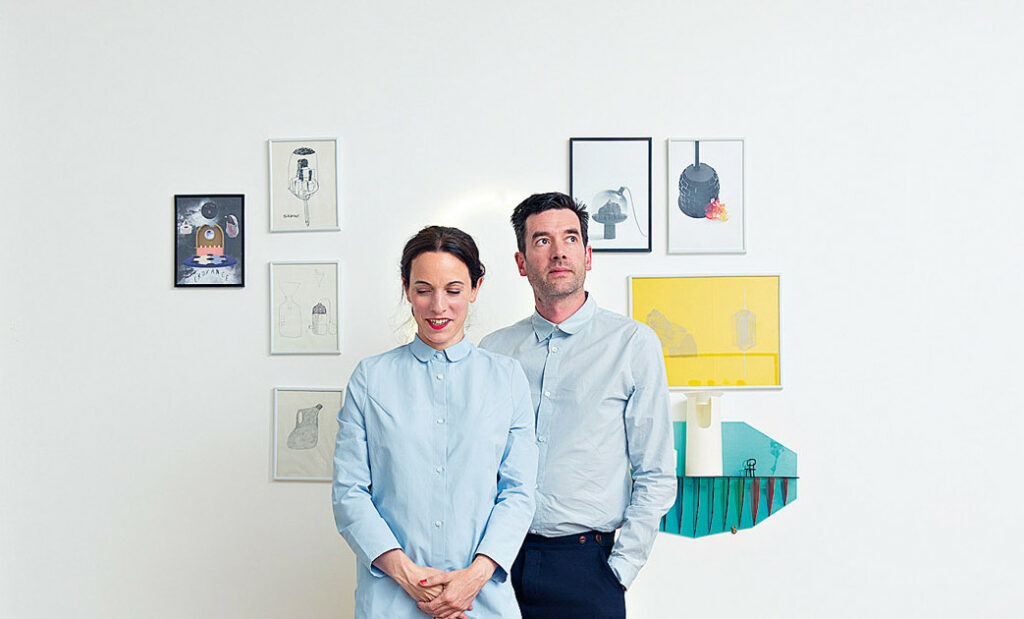
Studio GGSV and the Question Behind the Commission
The brief arrived on the centenary of Art Deco. At that moment, the director of the Mobilier National posed a clear challenge. Specifically, what could the ensemblier mean in 2025?
This was a French tradition with deep roots. In essence, it treated an interior as a single composition. Architecture, fixed décor, and furniture all spoke as one voice. Art Deco was the last great style to fully achieve this.
After that, design fragmented into individual objects. Gradually, the integrated vision disappeared entirely. Studio GGSV answered that challenge with Les Salons de l’imaginaire — The Salons of Imagination.
Consequently, the project took shape inside the Pavillon d’Angiviller at the historic Manufacture des Gobelins in Paris. Furthermore, every piece of furniture was designed from scratch, and several works had never been shown before.
Studio GGSV Turns History Into a Living Surface
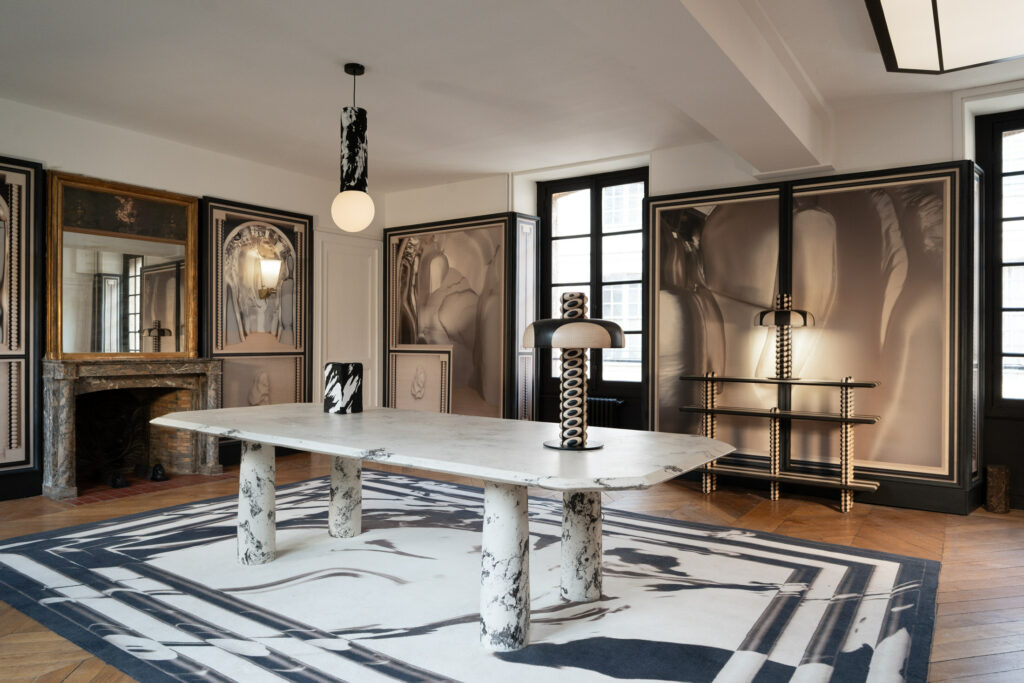
The first room is the Reception Salon. Here, a monumental library stands at the center of the space. Specifically, its columns twist and alternate — black wood, then white, then black again. The rhythm references Louis XIII furniture. Yet Studio GGSV rebuilt it in laminated layers of sycamore and bog oak.
That single material decision changes how the whole room reads. Stand at one angle and the surface reads as pure pattern. As a result of shifting slightly, it becomes architecture. Furthermore, wall panels carry the same geometry outward across every molded surface. Pilasters oscillate between decoration and structural logic. Consequently, the line between applied décor and architecture dissolves completely.
Indeed, the room refuses to settle into any fixed identity — and that is entirely by design. Sofia reads this tension with real precision. Rather than decoding the room for the reader, she restores the experience of looking. In doing so, she connects the work directly to what the V&A identifies as the core of Art Deco thinking — design as an architecturally embedded system, not a surface applied afterward.
The Garden Room and the Sky Room
The Conversation Salon shifts the mood entirely.
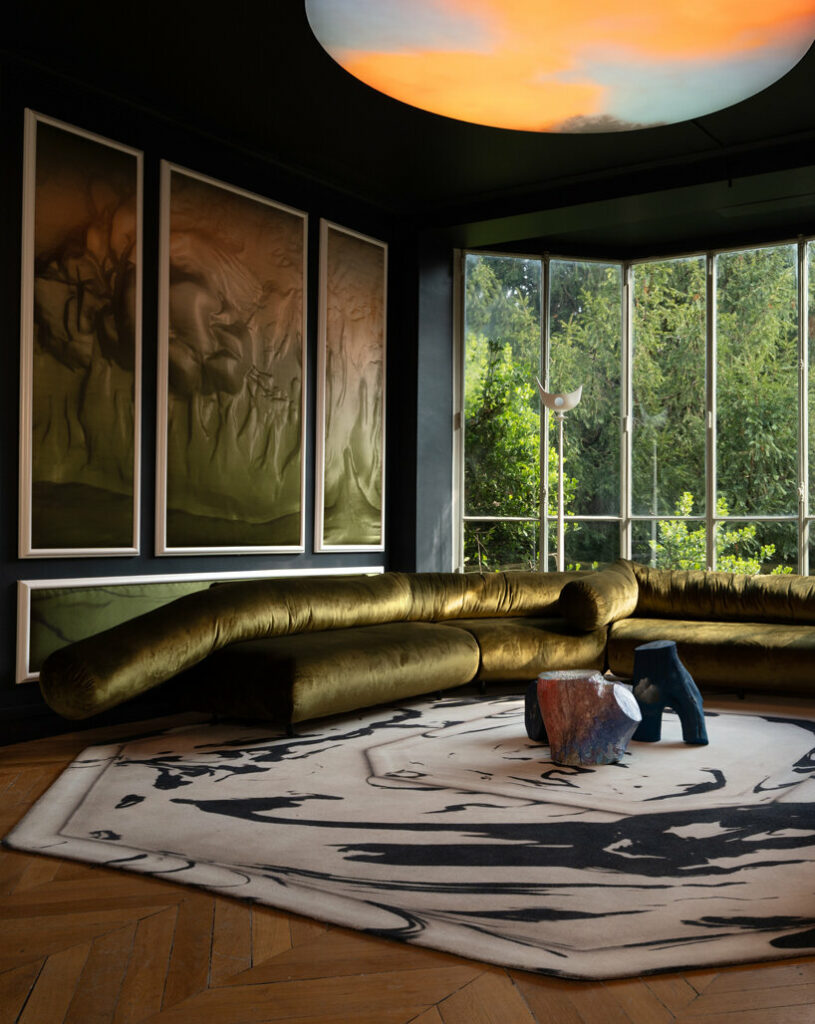
Here, a large hexagonal sofa anchors the room. In fact, its form is generous and deliberately oversized. Studio GGSV drew from two traditions at once. On one hand, French salon culture informed the structure and scale. On the other hand, Middle Eastern majlis customs shaped its open, circular hospitality. That cultural crossover is not merely decorative. Instead, it signals a studio that uses reference as active research.
Additionally, the walls carry textile frames in metallic verdigris relief. They graduate in tone, evoking garden foliage in filtered light. Meanwhile, a ceiling disc overhead suggests a sky in slow motion. As a result, the room feels like sitting inside a garden that cannot decide if it is real.
Moreover, tapestries by artist Xénia Lucie Laffely add woven landscapes of fire and greenery throughout.
The Room That Swallows You Whole
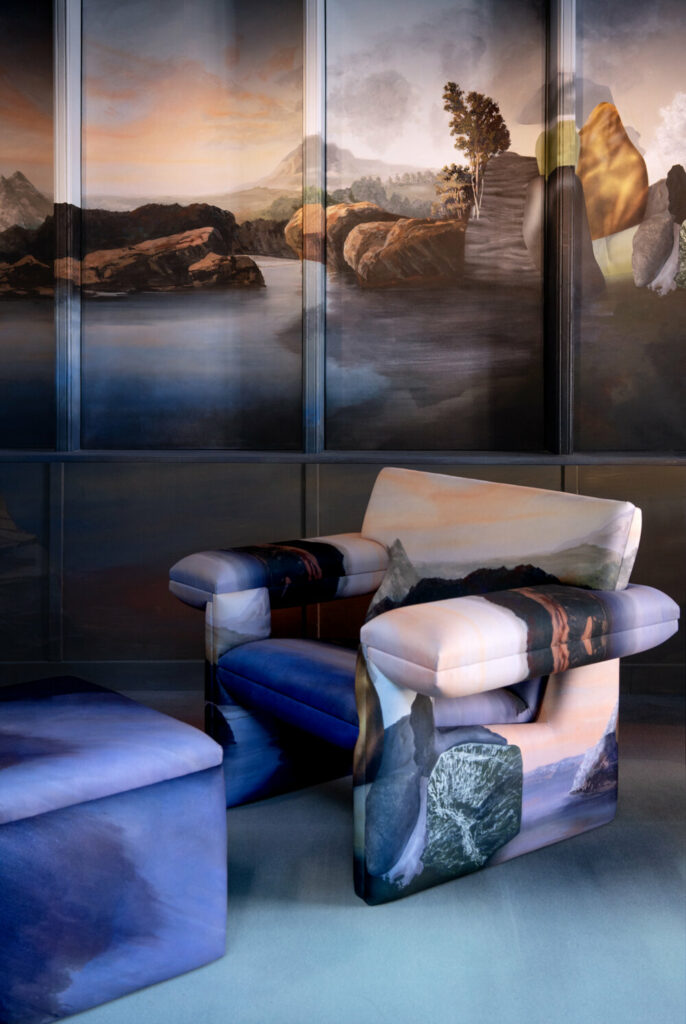
The Reading Salon is the installation’s most committed move. Here, romantic landscapes cover every surface without exception. In fact, walls, floor, and ceiling all become part of the same fresco.
The architecture dissolves completely.
Consequently, armchairs and libraries appear to grow directly from the painted landscape. Instead of looking at the room, you stand inside the painting. Furthermore, the floor is printed to resemble a blurred lake. As a result, the boundary between furniture and fresco disappears entirely. Hammered aluminum sconces scatter impressionistic colour across every surface. Even the distinction between interior and exterior dissolves here.
This is where Sofia’s coverage earns its highest marks. Rather than summarising, she builds the atmosphere through carefully accumulated detail. Consequently, her conclusion arrives naturally — carried by the weight of what came before.
How the Artisans Made It Real
None of this happened without extraordinary craft.
Together, Studio GGSV and the artisans of the Manufactures Nationales built something rare. Indeed, the institution brings more than 53 artisanal trades under one roof. The Sèvres workshops produced porcelain vases with petit feu decoration. Meanwhile, the Atelier de Recherche et de Création built the library, console, and lamps.Furthermore, every single piece assembles without a screw.
That last detail matters far more than it first appears. After all, eliminating screws is not a styling choice. Rather, form and material carry the entire structural logic on their own. As a result, the maker, the material, and the user share a direct and honest relationship.
This is exactly the kind of material thinking I explore on intellence.eu — where craft logic, assembly intelligence, and furniture design meet in the same conversation.
What This Project Is Really Arguing
The design industry fragments interiors constantly. Typically, a sofa arrives from one source and a light from another. Consequently, nothing converses with anything else, and the room never coheres. Studio GGSV prove that coherence is achievable. However, it requires designing the whole relational field from the start. Specifically, surfaces, volumes, materials, and light must all speak together. Sofia makes this argument legible throughout her coverage.
In particular, she structures the piece as a spatial sequence, moving room by room. In turn, each salon receives its own critical lens — and each lens earns its conclusion. Good furniture design requires understanding the space it will inhabit. Indeed, you design for the relational field — not just the object inside it.
Even so, the discipline rarely asks designers to consider the full system. That is precisely why projects like this one matter. You can read more about this thinking at intellence.eu/resume.
Studio GGSV operate at architectural scale.
Equally, the core thinking behind their work applies to any designer working at any scale.
Above all, their project at the Manufactures Nationales proves that the integrated interior never disappeared — it was simply waiting to be rebuilt. If integrated thinking, material logic, and craft heritage connect with your own practice, I explore these intersections regularly at intellence.eu/news. My work spans furniture design, industrial design, and international product strategy. The same conviction runs through all of it: the best design decisions are systems decisions. You can explore my full professional background at intellence.eu/resume.