A Cognitive Factory is no longer a futurist’s buzzword. In 2026, factory floors across the globe are transforming into living, intelligent ecosystems that think, adapt, and collaborate. And as a result, the way companies design, test, and assemble products is advancing at a pace that is, frankly, breathtaking.
Cognitive Factory and the Leap to Industry 5.0
To understand where we are today, it helps to look briefly at where we came from. Industry 4.0 connected machines to networks, generated vast oceans of data, and introduced the concept of the “smart factory.” However, connectivity alone was never enough. Consequently, the industry pivoted hard. Industry 5.0 goes further — and it goes deeper. Rather than simply linking machines together, it fuses self-learning AI systems directly into the decision-making fabric of production. Furthermore, it repositions the human being — not as a machine operator, but as a genuine partner alongside intelligent systems.
Two converging forces drive this transformation: high-fidelity digital twins and humanoid robotics. Together, they are rewriting the rules of what a factory can achieve.
How Digital Twins Revolutionize the Design Process
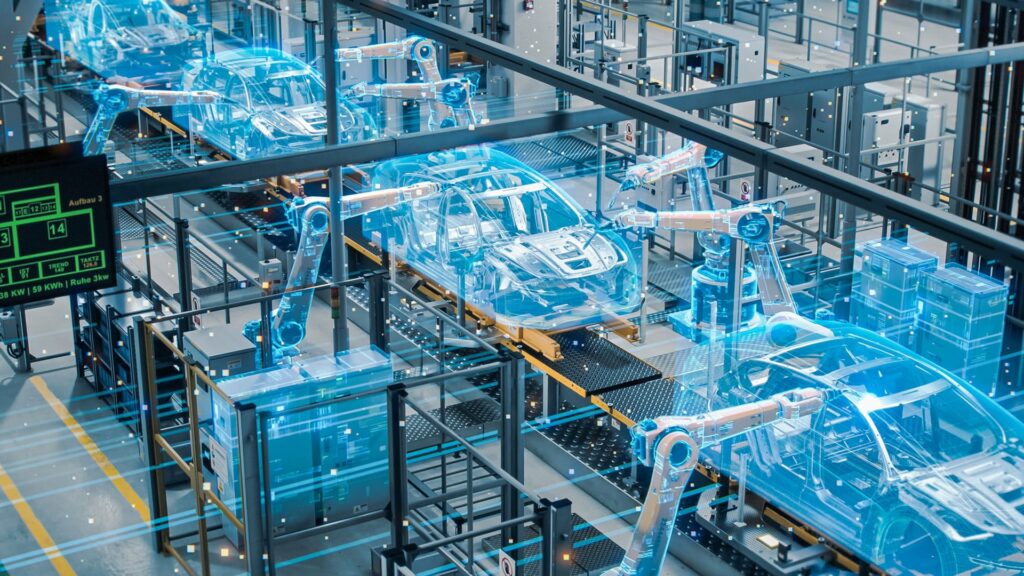
Think of a digital twin not as a 3D model on a screen, but as a living, breathing mirror of an entire factory — one that updates in real time, fed by sensor data from every machine, workstation, and supply chain node. Moreover, engineers now call these “decision-grade” twins: sophisticated enough to simulate friction, heat, material stress, and ergonomic strain with near-perfect accuracy.
For product designers and engineers, this shift changes everything. Previously, validating a new assembly sequence or a redesigned workstation required physical prototypes, tooling investments, and weeks of testing. Now, however, all of that validation happens inside the simulation. Designers can consequently explore bolder geometries, unconventional materials, and more complex assembly sequences, because the twin verifies manufacturability and sustainability metrics long before anyone cuts a mold or builds a jig. In other words, iteration becomes nearly free. And as a result, the cost of creative ambition drops to almost zero.
Cognitive Factory Meets Humanoid Robotics: A New Kind of Collaborator
Meanwhile, on the physical side of this transformation, something equally significant is taking shape. Humanoid robots — once the exclusive property of science fiction — are stepping onto production lines as standard industrial actors. Platforms like Boston Dynamics’ Atlas and Tesla’s Optimus have moved well beyond pilots and proof-of-concept experiments. They are, increasingly, part of the active workforce.
What makes humanoid robots particularly consequential is their form factor. Because engineers build them around human proportions — two arms, two legs, a similar reach envelope and centre of gravity — they can work in spaces and with tools that nobody ever designed for traditional automation. They therefore slot into existing workflows without forcing companies through the expensive and time-consuming process of redesigning entire production environments around them.
This, in turn, opens a genuinely new design brief. Rather than optimising a product purely for human assembly, designers can now co-optimise for a shared human–humanoid user. Handle geometries, grip surfaces, weight distribution, assembly sequence logic — designers can tune all of these parameters simultaneously for both human ergonomics and robot-compatible tolerances. Furthermore, that co-optimisation happens entirely within the digital twin before physical production begins.
The Intelligence Layer: From Monitoring to Autonomous Decision-Making
Beyond robotics, the cognitive factory introduces a further layer of intelligence into operational technology. AI agents embedded in control systems no longer simply flag bottlenecks to human supervisors. Instead, they autonomously re-sequence production lines, adjust robotic velocities, and initiate predictive maintenance — all in real time, without human intervention. Additionally, edge-AI processors embedded directly in individual machines allow millisecond-level self-correction, compensating for microscopic material defects or thermal drift before a faulty part ever leaves the workcell.
The combined effect pushes factories closer to the industry’s most ambitious goal: zero-defect manufacturing. Nevertheless, it is equally important to note that none of this shrinks the role of the human. On the contrary, workers move up from operators to orchestrators — supervising AI systems, handling genuine exceptions, and directing the intelligence of the factory toward strategic outcomes. The goal, ultimately, is not to automate people out. It is, instead, to absorb the dull, the dangerous, and the repetitive — and to free human creativity for where it matters most.
What This Means for Product Designers and Industrial Engineers
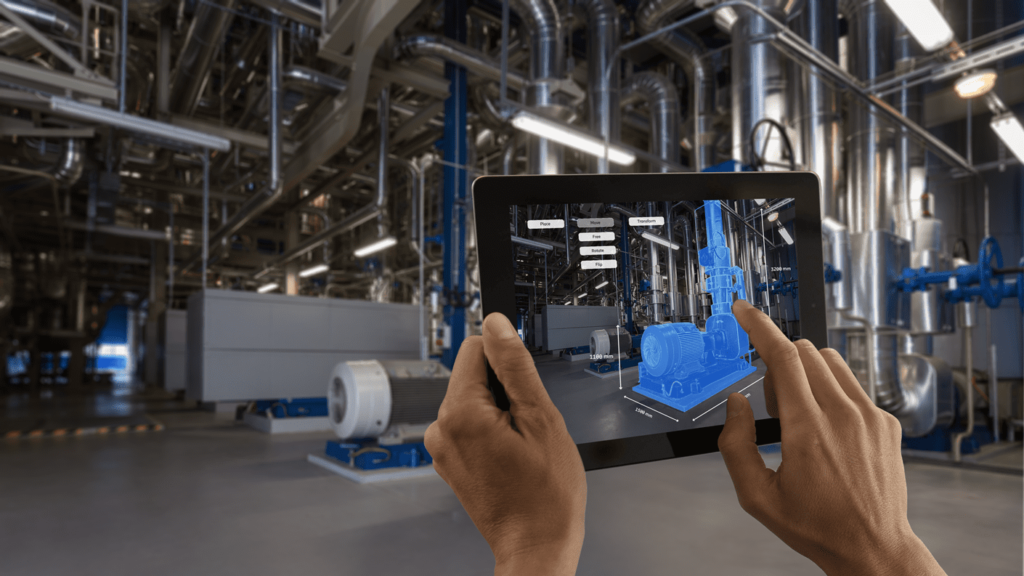
The practical implications of the cognitive factory for designers and engineers run deep. First and foremost, the risk profile of innovation changes entirely. Novel forms, unusual materials, and complex multi-component assemblies stop being guesses — they become validated hypotheses. Moreover, designers can bake sustainability metrics — carbon footprint, material origin, energy consumption — into the process from day one, rather than retrofitting them at the end.
Furthermore, as NVIDIA’s Omniverse platform demonstrates, design tools and factory simulation environments are converging into unified workflows. In other words, the boundary between product design and process design is dissolving. Consequently, tomorrow’s designer does not simply create objects. They design objects and the intelligent system that builds them.
Designing for the Cognitive Factory: A Portfolio of Proof
This convergence of physical and digital intelligence is precisely where the expertise built across projects at intellence.eu/work delivers real value. With a professional background spanning CAD/CAM design, steel and metal construction, ergonomic workstation development, industrial lifting machinery, and furniture manufacturing — as detailed at intellence.eu/resume — this body of work already aligns with the demands of the new industrial era. Every project reflects the same core discipline: designing products that serve both human ergonomics and manufacturing efficiency, validating assembly logic through detailed technical drawings and digital exports, and bridging the gap between creative concept and physical production. As the cognitive factory becomes the standard, that discipline becomes more valuable, not less.
Looking Ahead
The cognitive factory is not a destination. It is, rather, a direction — one that will continue to accelerate toward 2030 and beyond. As digital twins grow more precise, as humanoid robots grow more capable, and as AI agents grow more autonomous, the factories of the near future will function as collaborative intelligence systems. Nevertheless, the human being will remain at the centre — not as a machine-minder, but as the creative and strategic force that gives all of this intelligence its purpose.
The question, therefore, is not whether this transformation is coming. It is already here. The question is whether you are designing for it.
🔗 External Links Referenced in This Article
NVIDIA Omniverse (Digital Twin Platform) — https://www.nvidia.com/en-us/omniverse/
Boston Dynamics Atlas — https://bostondynamics.com/atlas/
Tesla Optimus — https://www.tesla.com/AI