Modular input design is the quiet revolution that creative professionals have been demanding without quite knowing how to ask for it. For years, the designer’s desk told the same tired story — a keyboard here, a dial there, a trackpad shoved to the edge where it barely fits. Then, from a small studio in Groningen in the Netherlands, a startup named Naya arrived with a real answer.
Not a concept. Not a keynote. A product. And that product — the Naya Connect — proposes, with remarkable clarity, that modular input design is not a feature. It is a philosophy.
What Modular Input Design Actually Means in 2026
Modular input design, at its most honest, starts with a refusal. Naya refuses to accept that a single fixed configuration can serve the full range of what a creative professional does in a single afternoon. The Connect system builds itself around a 75% mechanical keyboard that acts as the anchor of a modular input ecosystem. Magnetic pogo-pin connectors on both sides of the keyboard accept a growing family of hot-swappable input modules. So the keyboard, therefore, is not the product — it is the foundation.
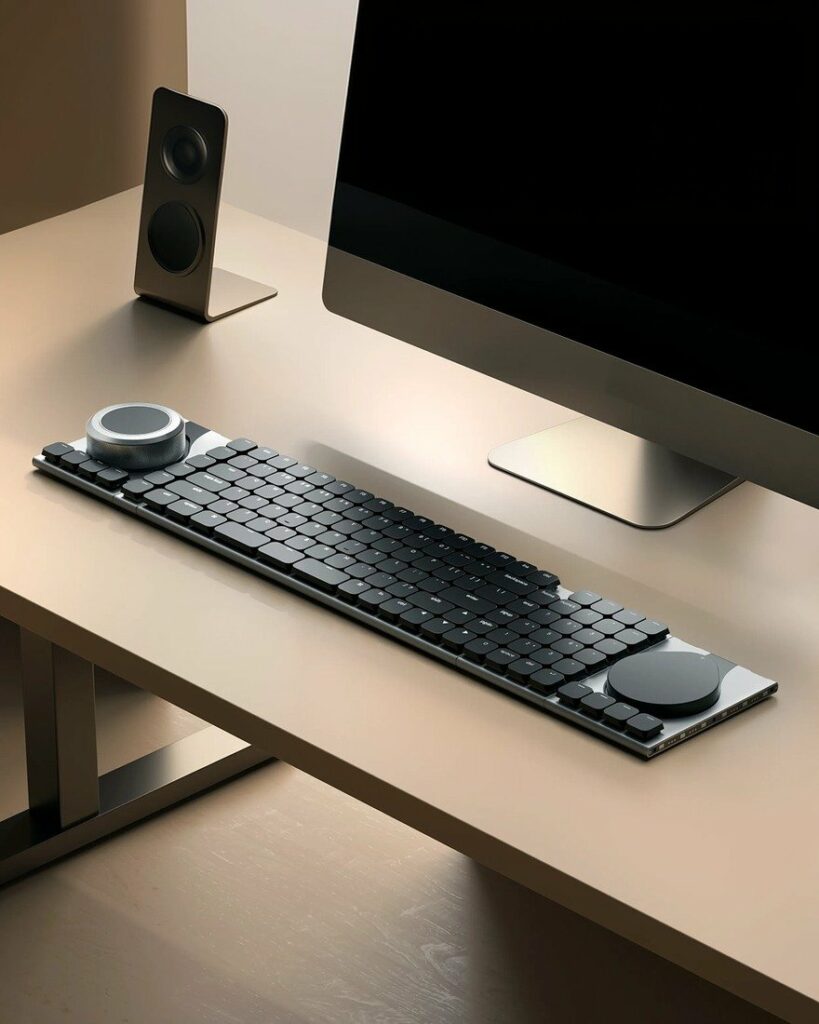
That reframing, from static tool to living platform, is where the real design thinking of the Naya Connect begins. Modular input design, in this reading, does not mean adding accessories. It means reimagining the relationship between the creative hand and the machine it touches every day.
The Keyboard as a Platform
The Naya Type keyboard sits at the centre of this modular input design system, and it earns that position through material precision alone. Naya machines the unibody from a single block of aluminum, cutting it down to just 14.9mm thick, then loads it with hot-swappable Kailh Choc V2 low-profile switches and dished polycarbonate shine-through keycaps.
As a standalone object, it already impresses. Its matte finish speaks of permanence without arrogance. Its proportions feel measured and deliberate. Nothing here sits on the surface for purely decorative reasons — every decision earns its place. And yet the keyboard’s most important quality is not what it does alone, but what it invites. As a modular input design platform, it suggests that the desk can be built, rebuilt, and refined as often as the work demands. That openness is itself the point.
The Module Family
When the modules arrive, the modular input design system finally finds its full voice. Naya offers four controllers for the Dock: the Touch, a compact touchpad with configurable gesture zones; the Track, a 40mm optical trackball with programmable buttons; the Tune, a rotary encoder dial for precision parameter control; and the Float, a 6-degree-of-freedom spatial input device built specifically for 3D artists and CAD engineers. Each controller slots into the same Dock through a unified connection standard. As a result, the physical footprint on the desk never changes — only the function does.
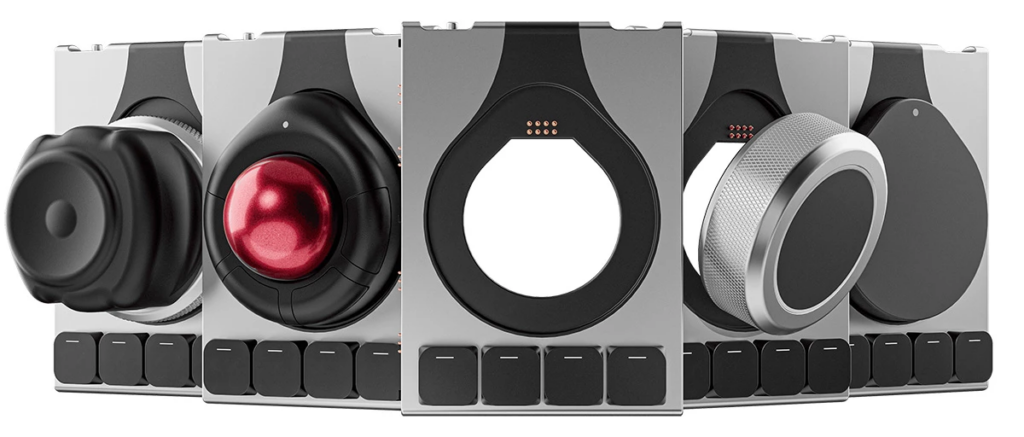
This is modular input design operating at its most intelligent: the form stays constant while the capability transforms entirely. Beyond the Dock, the Multipad — a 24-key numpad and macropad with addressable RGB — and the 6-Key, a slim programmable strip for quick-access shortcuts, extend the system laterally on either side of the keyboard. Together, these modules build a complete language of modular input design — one where the user, not the manufacturer, writes the grammar.
The Float — Most Radical Idea
Among all the expressions of modular input design that Naya has produced, the Float stands as the most provocative. It gives the user 6 degrees of freedom across all spatial axes simultaneously, while a 2D rotary encoder at its base handles additional mapped input. For a 3D artist navigating a complex mesh, or a CAD engineer rotating a structural assembly, this controller changes the relationship between the body and virtual space entirely.
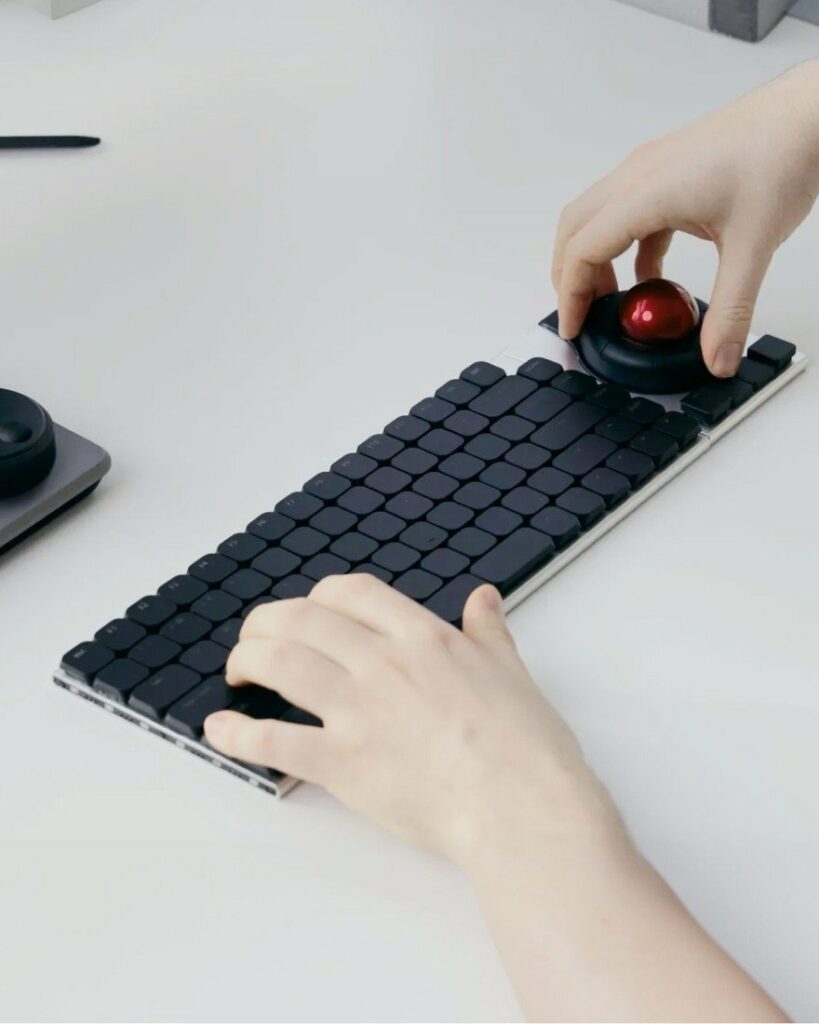
What makes it remarkable, however, is not its capability in isolation — it is its integration. The Float sits quietly in a Dock beside the keyboard, not demanding a separate corner of the desk or a separate cable to manage. It belongs to the system. It looks like it belongs. That coherence is where the modular input design ambition of the Naya Connect becomes fully visible, and fully convincing.
Modular Input Design Demands Intelligent Software
Every serious modular input design requires a software layer worthy of its hardware. Naya understands this instinctively. Naya Flow manages the entire system — keyboard, dock, and all attached modules — through a single, unified interface. It handles key remapping, multi-layer layouts, per-application automatic profile switching, per-key RGB control, and detailed module configuration including trackball sensitivity, touchpad zone mapping, and all six axes of the Float. Importantly, the system stores all profiles directly on the hardware itself.
This means the modular input design setup runs without any software installed — a decision that signals genuine integrity, one that trusts the object over the cloud. Furthermore, the per-application automatic switching means the same physical rotary dial behaves differently in a video editing timeline than it does in a 3D modeling environment or a music production session. The system reads where the user is, then adjusts accordingly. That invisible intelligence is modular input design working at its best — and it is precisely where so many otherwise excellent hardware systems quietly fail.
What the Market Told Modular Input Design in Six Minutes
The market responded with unusual speed and unusual clarity. Within six minutes of the Kickstarter campaign launching, the Naya Connect surpassed its funding target. By the time wider attention arrived, over $470,000 in pledges had accumulated, with significant campaign time still remaining. This is not simply a crowdfunding success story. It is a signal — loud and unambiguous — that a generation of creative professionals has been quietly waiting for exactly this kind of modular input design thinking to arrive in a form they can actually buy. Pricing for the all-in bundle, which includes the keyboard, two docks, all four controllers.
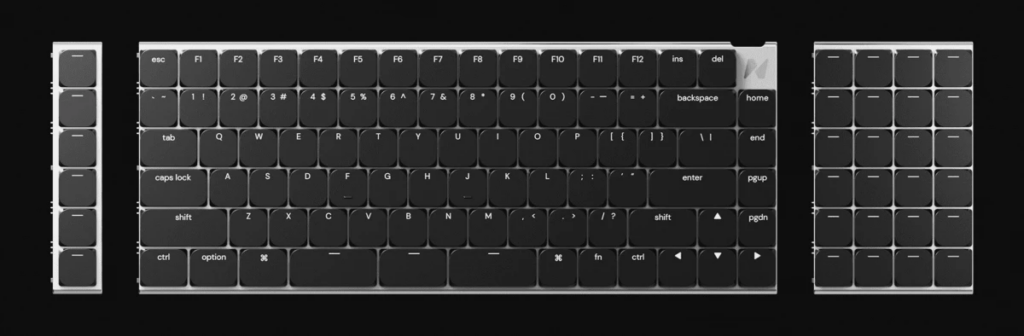
Multipad, and 6-Key, runs from approximately €568 to €786 depending on campaign tier. That is a considered investment. However, the modular input design system that Naya has built is a considered proposition — one that asks to be taken seriously, and earns that ask. Shipping begins in February 2027. The wait is long. The ambition, though, is longer.
Modular Input Design and the Honesty of the Seam
Above all else, what I admire most about the Naya Connect is its honesty. Most consumer hardware obsesses over smoothing away its own complexity, presenting a seamless surface and asking the user to trust and not inquire. Naya takes the opposite position. The modular input design system makes its own logic explicit and visible. The magnetic snap of a module connecting to the keyboard is a sensory event — deliberate, satisfying, and informative. It tells you something has changed. It tells you the system now works differently.
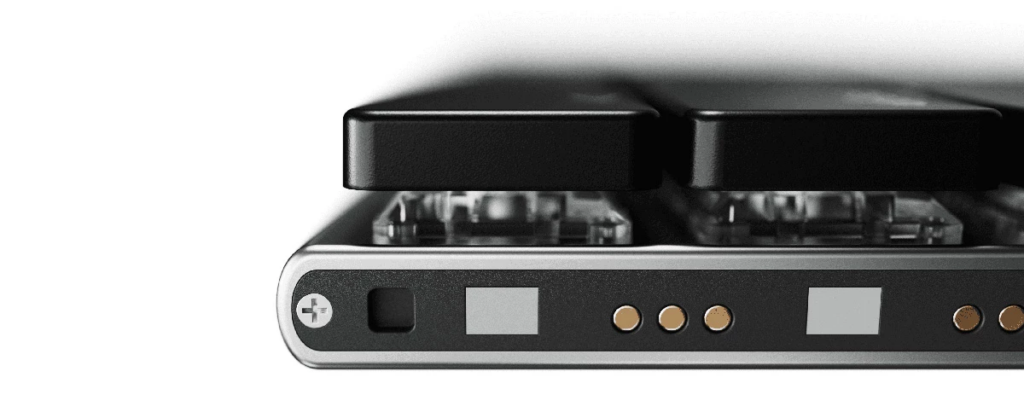
Moreover, the shared design language across every module — the same aluminum finish, the same restrained black palette, the same proportional logic — ensures that what could easily feel like a collection of mismatched gadgets reads instead as a coherent, intentional whole. Naya has made the seams part of the design. And in doing so, they have built a modular input design that is not merely functional but, in the truest critical sense, honest.
The Larger Conversation About Creative Tools
Modular input design, as Naya practices it, ultimately makes an argument about the nature of creative work itself. The desk is not a fixed stage. It shifts in character and requirement across the arc of any working day — from writing to modeling, from sound design to visual editing, from the precision of code to the freedom of concept. The tools on that desk should be alive to those shifts. They should adapt, reconfigure, and respond without demanding that the user stop, recalibrate, and lose momentum.
That adaptability — invisible when it works, maddening when it is absent — is what Naya has engineered into the physical layer of the workspace. The result is not simply a better keyboard or a smarter peripheral. It is a modular input design system that treats the creative professional as exactly what they are: a person whose work is never one thing, and whose tools, therefore, should never be either.
Modular Input Design Meets the Physical World
The conversation that modular input design opens — about adaptability, structural honesty, and the refusal to accept the standard configuration — runs through every discipline of applied design. It runs, in particular, through the work in my portfolio at intellence.eu/work. Each piece there — from the KrossBand and KrossDraw Cabinets with their intersecting structural geometries, to the sculptural resolution of the Revertion Bed and the origami logic of the Dorm MidTable — starts from the same instinct that drives the Naya Connect. The designed object must be honest about what holds it together, and responsive to the human body and the workflow it serves.
My background, documented at intellence.eu/resume, spans CAD/CAM fabrication, bespoke furniture manufacturing, and product design — disciplines built, like modular input design, at the precise crossroads of engineering constraint and artistic intention. The most enduring objects, whether they sit on your desk or furnish your room, are always the ones where structure and expression arrived together.