Living materials change the premise of design entirely. Researchers at the University of Washington now embed fungi and bacteria directly into structural building components. These organisms do not simply sit inside the material. They animate it — capturing carbon, filtering wastewater, and self-regenerating as climate conditions shift. Yet the implications of this work stretch far beyond construction. They reach into every object a designer touches.
For decades, sustainable design moved in exhausting circles. Brands replaced plastic with bamboo, swapped synthetic foam for recycled fill, and printed “eco-friendly” on packaging that outlived its promises by years. Still, none of that addressed the actual problem. Our materials remain inert. After we shape them, they do nothing. Eventually they sit, decay, and contribute nothing back to the systems that produced them. The UW research breaks that agreement at the root.
Living Materials Redefine What an Object Can Do
Consider what this means in concrete material terms. UW chemistry professor Alshakim Nelson points directly at construction’s roughly 40% share of global greenhouse gas emissions. His team’s goal, therefore, is to replace high-carbon inert materials with active, low-energy, self-sustaining alternatives. These components generate anticorrosive coatings from within, sequester CO₂ rather than emit it, and repair microbial damage without any external intervention. Furthermore, students at the university already scale this approach through 3D printing with water-based resin. Living walls emerge from this process — converting waste oil into biofuel and generating heat for buildings. None of this remains speculative. A working structural logic already drives it.
As a designer, I read this as a clear signal. The era of the passive object is over.
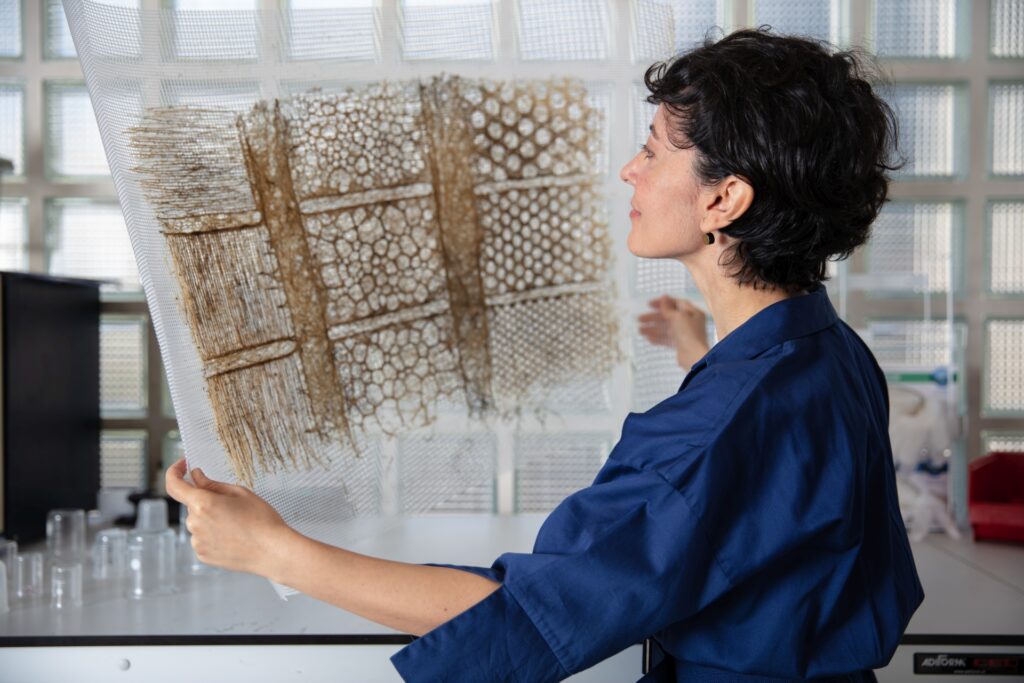
A New Design Choreography
Still, translating this logic from architecture into furniture and product design demands an entirely different kind of thinking. The designer no longer finalises the object. Instead, the designer sets the conditions for the object to become. That shift in role is enormous.
Consider a chair shell grown from mycelium composites. Over years of use, microbial activity drives colour shifts across its surface — the chair patinates, truthfully, the way aged wood or worn leather does. Or consider a gaming enclosure whose surface changes texture in response to humidity and air quality. On the other hand, imagine modular furniture panels that, at end of life, actively decompose into soil nutrients rather than entering a landfill. Moreover, they contribute carbon back into the ground in the process.
This thinking already has serious traction in design culture. Dezeen’s coverage of biomaterial furniture documents studios worldwide working with fungi, bacteria, and bio-based composites to produce objects that satisfy both structural performance and aesthetic ambition. Meanwhile, the Salone del Mobile has positioned mycelium and bio-composite materials as central to the next decade of design language. Consequently, the aesthetic question no longer needs defending. Living materials produce genuinely beautiful objects. The remaining question is whether designers carry the structural and conceptual fluency to work with them honestly.
The Interface Challenge
Beyond aesthetics, the real challenge sits in the interface between biology and hardware. Biology and engineered components follow entirely different logic. A machined part demands precision and repeatability. A fungal network, on the other hand, demands moisture, substrate, and time. Therefore, designing with living materials means choreographing a negotiation rather than executing a fixed specification.
Modular shells become essential — panels and components designed for replacement as they grow, age, or functionally transform. Finishes stop being coatings and become processes. Enclosures, in turn, stop generating end-of-life waste and start functioning as carbon sinks inside the built environment. Indeed, research platforms tracking mycelium applications in design confirm that companies like Mogu already demonstrate fungi-derived products meeting industrial durability standards while remaining fully biodegradable. As a result, the technical infrastructure supports this direction right now. What it still needs is vision at the object scale.
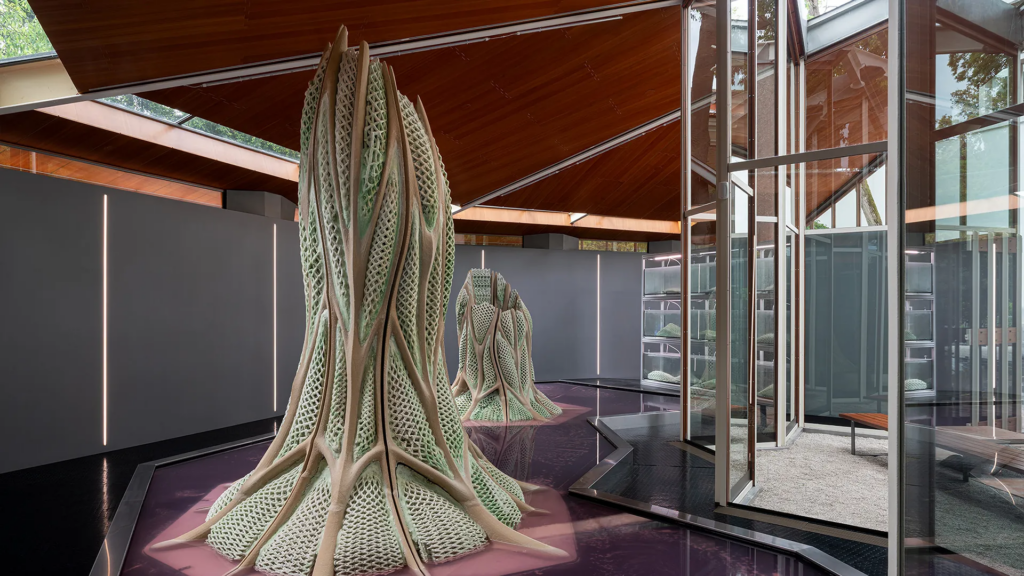
The Designer’s Real Responsibility
For too long, sustainability in design functioned as a veneer. Designers conceived objects with zero ecological logic, then applied a “sustainable” narrative afterward — like a coat of paint over an unchanged structure. However, living materials demand the inverse. They require the designer to start with biology and build outward. Because the material itself is a collaborator with its own timeline and intentions, the designer can no longer treat it as neutral.
Furthermore, there is an aesthetic argument here that goes beyond environmentalism entirely. Objects that breathe, repair, and age with authentic character carry a phenomenological weight that no injection-moulded surface replicates. Each one bears time. Every mark of use becomes part of its story. Through texture, colour, and growth, an object records the environment it inhabits — and in doing so, returns genuine meaning to ownership in ways that mass production abandoned decades ago.
Above all, the UW research does not only point toward greener buildings. It points toward a generation of objects that refuse to wait passively for the world to act on them. Instead, they act back. In other words, every object becomes exactly what the title of this piece claims: a living argument — for accountability, for material intelligence, and for design that earns its place in the world.
Living Materials, Engineering Rigour, and This Practice
The questions living materials raise — about modularity, growth cycles, biology-hardware interfaces, and carbon-positive end-of-life design — sit at the precise intersection of structural engineering and critical design thinking that defines my practice. This territory is not new ground for me. Earlier this year, I explored how lignin-based 3D printing turns wood industry waste into fully recyclable structural products — a process that shares the same foundational logic as UW’s water-based resin printing with living organisms: bio-derived material, additive fabrication, zero-waste intention.
Furthermore, my investigation into AI-driven materials discovery traced how computational tools now propose novel eco-smart materials and accelerate the shift toward circular, responsive products — exactly the research pipeline that living materials will feed into next. Together, these threads form a consistent position: that the most consequential design decisions of this decade happen at the material level, before a single form is drawn.