Spacesuit design rarely starts from the outside. The most critical layer sits closest to the skin. Not on the polished white shell that photographs so well on launch day.
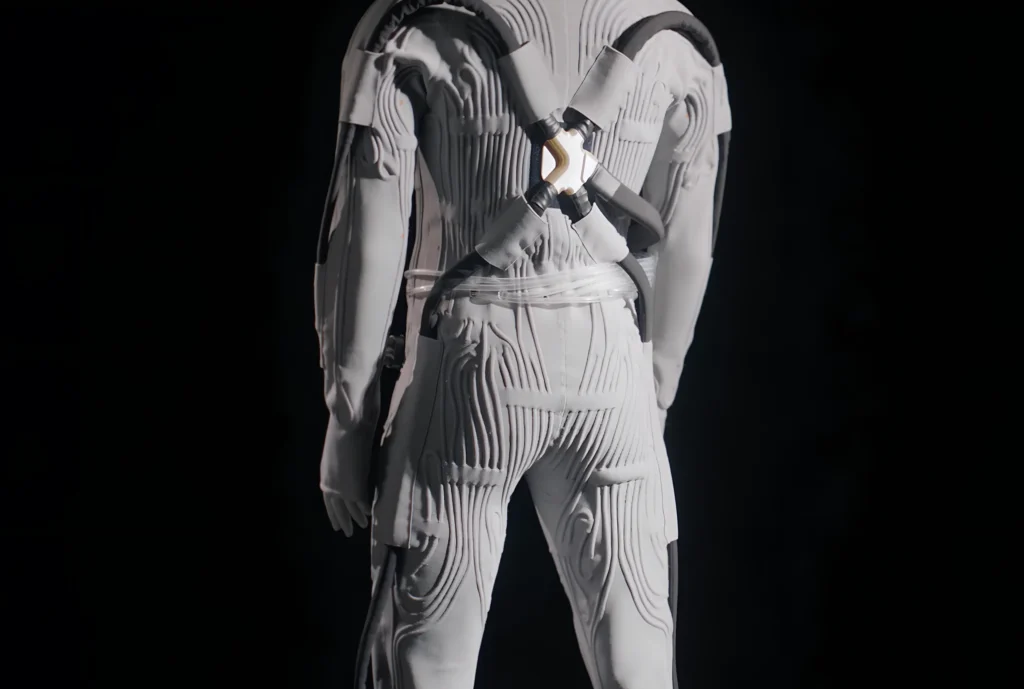
Prada and Axiom Space understand this completely. Together, they unveiled the Liquid Cooling and Ventilation Garment — the LCVG. It sits directly inside the AxEMU, built for NASA’s Artemis lunar missions.
When Artemis astronauts finally walk the lunar south pole, they will carry this garment beneath everything else. It will be the layer no camera ever sees. Consequently, it’s not simply clothing — it’s a full life-support system.
Furthermore, it controls temperature and manages respiration inside a hostile vacuum. And it does all of this while staying invisible beneath the outer shell.
How Spacesuit Design Moves From Surface to System
After all, every moonwalk generates massive metabolic heat inside the suit. Without active thermal management, that heat turns dangerous within minutes. The body needs a constant, reliable way to push that heat outward.
In response, the LCVG circulates cold water through flexible tubing across the body’s major muscle groups. That tubing absorbs excess heat and transfers it to the suit’s portable life-support system. The system then expels it into the vacuum of space.
Without this mechanism, a mission could end in under an hour. The body stays cool. The suit stays functional.
Notably, Prada and Axiom Space also built in fully redundant cooling circuits. If the primary loop fails mid-moonwalk, a backup activates instantly. Moreover, the system sustains peak performance across missions lasting up to eight hours.
Spacesuit Design Reveals Prada’s Material Intelligence
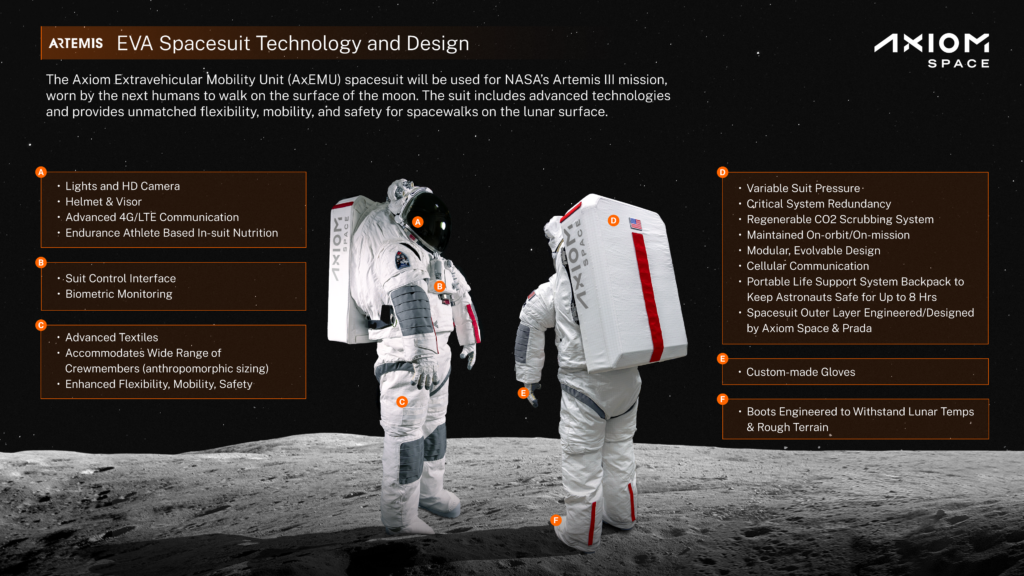
Indeed, this is not Prada’s first move into space. In 2024, the fashion house helped develop the AxEMU’s outer shell. It contributed materials designed to survive micrometeoroid impact and extreme lunar temperatures.
Now the collaboration moves inward — toward the layer where human physiology meets machine. Prada applied its expertise in engineered knitwear and three-dimensional textile construction. The result is a garment that holds tubing, connectors, and life-support hardware while staying lightweight.
Using advanced 3D modeling, Prada shaped the AxEMU’s inner layer carefully around the body’s contours. The priority was mobility. Astronauts work hard on the lunar surface, and nothing in the design can hold them back.
Additionally, Prada sourced specialized fibers to withstand the demands of repeated long-duration spaceflight. Therefore, this collaboration signals something genuinely significant. Luxury material research and aerospace engineering now share common ground — right inside spacesuit design.
How Spacesuit Design Addresses the Invisible Breath
Beyond thermal control, spacesuit design demands a second vital function from the LCVG. The garment incorporates a ventilation circuit that delivers fresh oxygen across the astronaut’s face. Simultaneously, it pulls exhaled CO2 away and routes it back for filtration and recirculation.
This is not a function most designers ever encounter. Garments typically end where air begins — at the surface of skin. The LCVG begins there and extends into a closed life-support loop.
In fact, carbon dioxide builds up quickly in a sealed environment. The human body generates it with every exhaled breath. At high concentrations, it impairs cognition before a crewmember even notices.
Above all, the LCVG does something more profound than cooling the body. Consequently, it sustains the act of breathing in an environment that refuses to support it. Furthermore, it achieves this at a scale small enough to fold into a carry case.
Spacesuit Design and the Broader Lesson of Hidden Architecture
In fact, the Prada–Axiom LCVG offers a lesson that reaches far beyond spacesuit design. It applies to product design at every scale and in every discipline. The most critical elements of a well-made object often sit completely out of sight.
Thermal management, structural redundancy, and material intelligence rarely announce themselves visually. Yet they determine whether a product holds up or fails under real conditions. Meanwhile, the more visible outer layer captures all the attention.
This inversion holds across furniture, industrial design, and now lunar exploration. After all, what holds a chair together is never visible from the showroom floor. The same truth applies sixty-two miles above it.
Accordingly, the most honest design question is not how something looks — it’s what an object must endure. Prada and Axiom answer it directly. They built the most essential spacesuit design brief any studio has ever accepted.
What Spacesuit Design Means for Material-Led Industrial Practice
Specifically, the LCVG carries direct relevance for anyone working at the boundary of engineering and material research. At Intellence, my practice begins from the same fundamental question this project poses. What does this object need to survive — and what does its user need to thrive?
This question drives every material specification, structural decision, and prototype I build. The context changes with each project — factory floor, domestic interior, or lunar surface. The discipline never does.
Across my work — from crane and steel manufacturing to furniture series and product prototyping — this principle returns every time. In particular, my background spans fluid mechanics, airflow thermodynamics, and two decades of CAD-driven industrial prototyping. A cooling circuit inside a three-dimensional textile form is, at its core, a thermal distribution problem.
It lives at the exact boundary of engineering precision and material craft. Prada and Axiom Space solved it brilliantly — and that is what superior industrial design looks like.
When astronauts step onto the lunar surface, cameras will follow the footprints forming in grey dust. Everyone will watch the AxEMU’s outer shell move through history. Nevertheless, the most remarkable piece of design enabling that moment will stay invisible.
Pressed against the skin, cooling muscles, clearing breath — holding human existence together a quarter-million miles from home. No photograph will capture it. The LCVG proves that the most powerful design decisions work best when nobody sees them at all.