Patent infringement represents the ultimate nightmare for any creator, capable of erasing years of intensive development overnight. As an industrial designer evaluating modern innovations, I view commercial goods through a dual lens of structural aesthetics and legal durability. Every curve, mechanism, and physical layout in a successful product carries an invisible shield of law. Unfortunately, navigating the vast grid of contemporary intellectual property often feels like walking through a minefield. If you lack a clear compass, you will inevitably step on a legal obstacle that can instantly destroy your brand’s hard work.
Therefore, product creators must learn to dissect the operational landscape long before manufacturing a single component. The brilliant strategists at the Industrial Design Consultancy outline three distinct pathways to safely navigate around competitor terrain. By embedding these techniques into your creative workflow, you actively shield your company while sculpting breathtaking physical narratives. Consequently, you transform legal limitations into spectacular raw material for artistic breakthroughs.
Designing a Clear Framework to Prevent Patent Infringement
Moreover, creators frequently fall into the trap of isolation, believing their ideas bloom in a vacuum. You must treat the global patent database as a massive, functional library rather than a terrifying labyrinth. However, searching through thousands of dense documents often confuses developers, stalling momentum when speed matters most. Let us break down the first procedural tool to isolate potential patent infringement: the Invent and Check method.
This specific methodology serves slower-moving industries where legal combat rarely occurs. Initially, you unleash your creative energy entirely on user advantage, crafting radical systems without immediate constraints. Afterward, you execute a targeted patent search to cross-examine your breakthrough against historical records. If the radar remains clear, you immediately draft your filing. Conversely, if an obstacle emerges, you swiftly pivot your geometry during the early sketch phase. This early agility saves astronomical costs down the road, as evidenced by historic multi-billion-dollar product disputes.
Real-World Case Studies on Patent Infringement
Furthermore, defensive design requires an entirely different posture when you enter highly mature markets. When a pioneering competitor captures public attention with a specific technology, the market instantly demands similar performance. In this high-stakes arena, you must deploy the Identify and Avoid framework to successfully bypass any threat of patent infringement.
First, you collect the competitor’s exact documentation and isolate the legal claims with absolute precision. You must understand precisely what the text covers, alongside what the boundaries exclude. Next, you reverse-engineer the core functional principle, stripping away the competitor’s specific execution to reveal the underlying physics. Consequently, you invent alternative mechanical pathways that deliver identical consumer utility without mimicking the protected structural configuration. Finally, you submit these fresh concepts to a specialist attorney to secure a formal non-infringement opinion before building physical tooling.
A Systematic Blueprint to Banish Patent Infringement
Nevertheless, hyper-competitive sectors require an even more rigorous, dual-track approach. When dozens of overlapping technologies crowd a market, individual searches provide insufficient coverage. Under these intense conditions, the Search, Invent, and Check strategy offers the safest refuge to eliminate the risk of patent infringement.
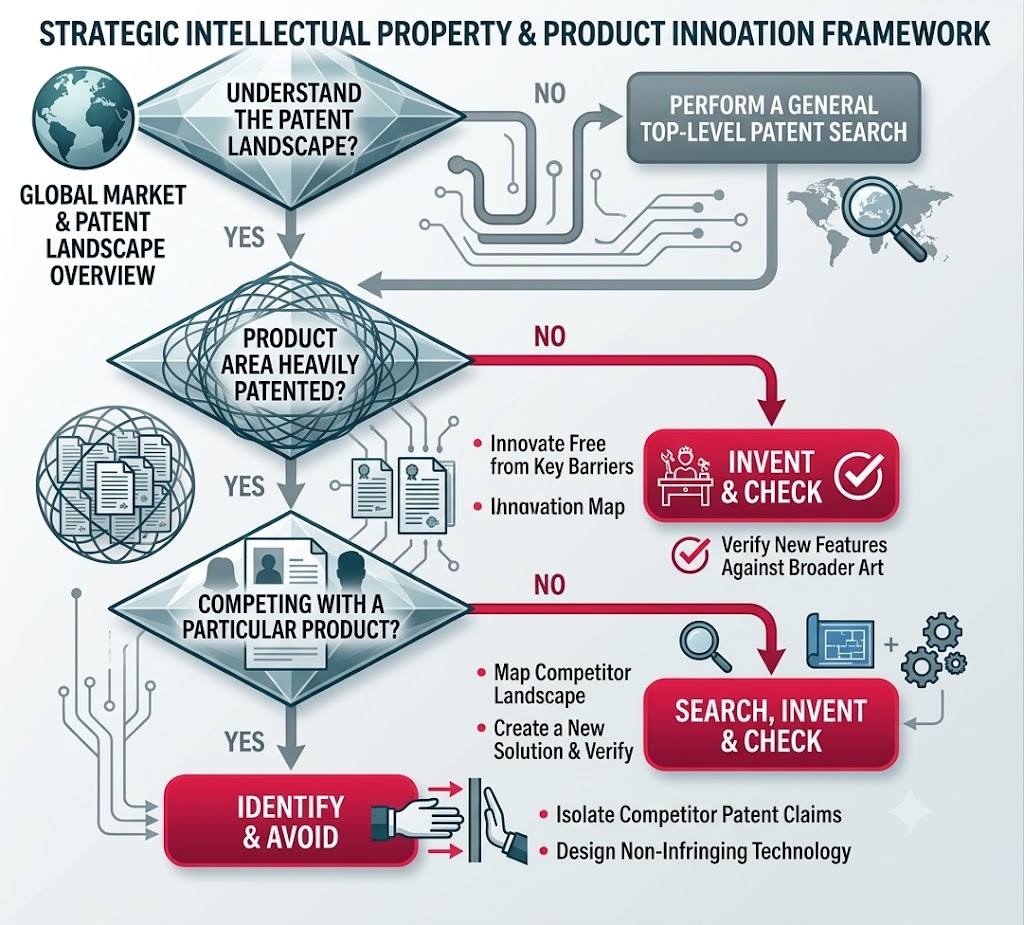
Simultaneously, you map out established competitor clusters while your studio drafts independent functional prototypes. You explicitly use the ease of avoiding these identified boundaries as a foundational metric for selecting your final direction. This rigorous synthesis ensures that your ultimate product embodies both artistic brilliance and ironclad legal safety. For comprehensive regulatory guidance on complex mechanical frameworks, inventors frequently consult the digital archives of the World Intellectual Property Organization, which catalog global structural precedents.
Blending Aesthetic Engineering with Digital Strategy
Ultimately, avoiding litigation requires a deep synthesis of physical engineering, historical awareness, and strategic brand positioning. My own professional journey reflects this exact intersection of disciplines. Whether analyzing the structural silhouette of a medical device or developing advanced web architectures at Intellence Resume, I treat every project as an interconnected ecosystem. True innovation requires us to respect structural boundaries while radically redefining the user experience.
On our corporate agency platform, we continuously examine how digital transformation and intellectual asset protection redefine modern commerce. If you explore our deep-dive analysis on the Intellence News Hub, you will discover how modern digital frameworks complement these physical design strategies. Merging rigorous legal frameworks with cutting-edge technological development allows brands to capture markets without fear of sudden disruption.
To further refine your structural strategy, you can explore the official United States Patent and Trademark Office portal, which offers interactive classification tools for modern developers. Treat these legal records as an ongoing masterclass in form and function. By mastering these three defensive pillars to neutralize potential patent infringement, you ensure that your product stands tall, transforming your portfolio into a lasting monument of secure, unassailable innovation.