Materials discovery has always been the secret bottleneck in design. Picture this: You’re sitting in your studio, wrestling with a familiar frustration. You need a material that’s sustainable, thermally responsive, and has just the right tactile quality—but nothing in your supplier catalogs quite fits. You start the usual dance: emails, phone calls, physical samples, weeks of waiting.
Now imagine a different scenario. You describe what you need to an intelligent system, and within minutes, it proposes three materials you’ve never heard of—each one computationally optimized for your exact specifications. One is a bio-based composite that exceeds your strength requirements while being fully circular. Another adapts its texture based on temperature. This is materials discovery in 2026, and it’s fundamentally changing how designers work.
AI has become the most powerful tool in materials discovery, transforming what used to take months into days. Moreover, this revolution isn’t just about speed—it’s about possibilities that simply didn’t exist before.
A groundbreaking Springer publication recently laid out the blueprint for this transformation, and what it reveals is stunning. The research shows how materials discovery has evolved from educated guesswork into computational science—covering everything from AI-assisted discovery methods to smart materials that respond to their environment, from energy-efficient building systems to advanced magnetic materials that enable new technologies. But here’s what really matters for designers: these aren’t just laboratory curiosities. Instead, they represent a fundamental shift in how we conceptualize and create products from the very first sketch.
Why Materials Discovery Used to Be So Painfully Slow
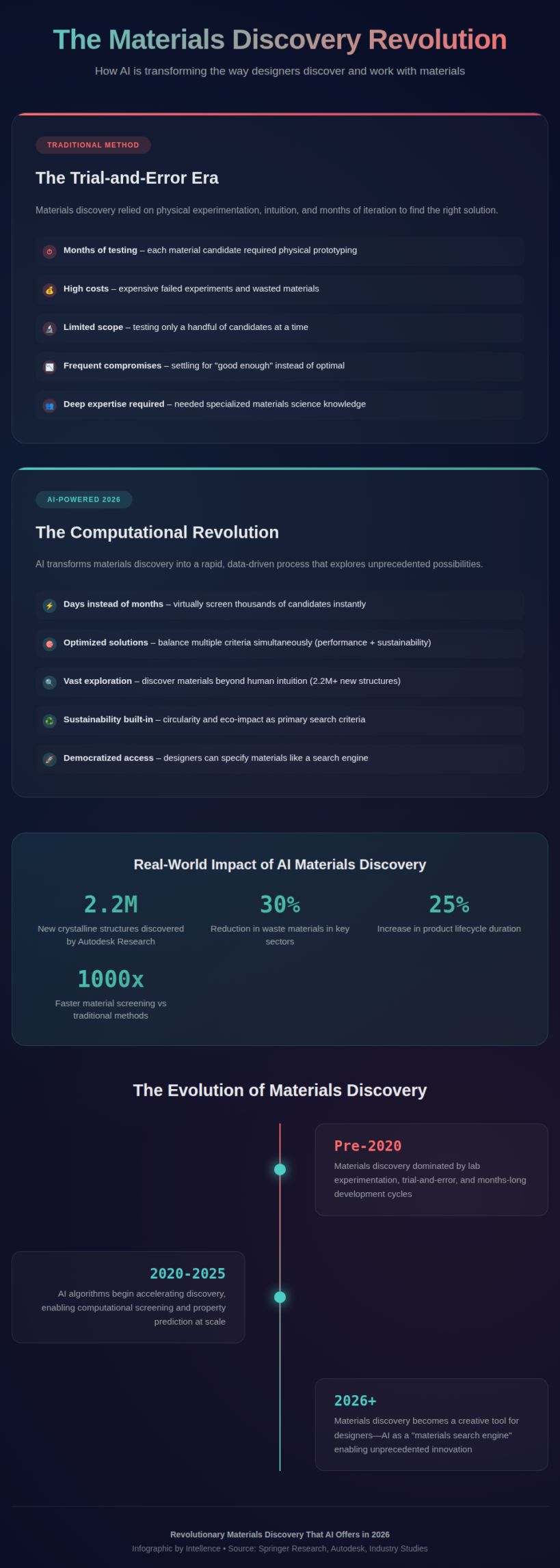
Let me tell you about the old way. A materials scientist would have an idea—maybe a polymer with specific flexibility and heat resistance. Then came the grind: synthesizing candidates, testing them one by one, documenting failures, adjusting formulas. Months would pass. Budgets would balloon. This is because materials discovery traditionally required sifting through tens of millions of possible molecular structures, searching for that one viable option like finding a specific grain of sand on an entire beach.
That’s all changing now. AI algorithms can virtually screen thousands of material candidates in the time it once took to test just one. Furthermore, these systems predict material properties with remarkable accuracy, mine vast databases for patterns humans would never spot, and optimize across multiple criteria simultaneously. Consequently, designers can now explore material possibilities that would have been completely impractical just a few years ago.
When Your Materials Become as Smart as Your Designs
Beyond just finding materials faster, we’re entering an era where materials themselves become active design partners. What if the chair you’re designing could automatically adjust its surface texture when someone sits down? Or a building facade could intelligently regulate heat flow without any mechanical systems?
Smart materials—substances that change their properties in response to temperature, pressure, light, or electrical stimuli—are being optimized through AI to create capabilities that sound like magic. The AI analyzes enormous datasets to identify materials with characteristics that perfectly match your vision, optimizing for durability, flexibility, responsiveness, and sustainability simultaneously. The result? Products where visible behaviors aren’t cosmetic additions but fundamental characteristics built in at the molecular level.
The Aesthetic Revolution You Didn’t See Coming
When materials discovery becomes computational, the aesthetic possibilities explode. You’re not limited to what’s in the catalog—you can explore forms and functions that were previously just sketches filed away as “impossible.”
Consider what Autodesk Research recently achieved: 2.2 million new crystalline structures discovered through automation that had completely escaped human intuition. Meanwhile, studies show that AI-driven materials discovery combined with eco-innovation is already reducing waste by up to 30% in some sectors while boosting product lifecycles by 25%. For furniture designers, this means creating pieces whose durability and circularity are embedded at the molecular level. For electronics creators, it means devices where sustainability isn’t a marketing add-on but a fundamental characteristic.
Making It Real: From Computational to Tangible
What makes this particularly powerful for designers is how materials discovery democratizes expertise that used to require years of specialized training. Before, if you wanted to specify a novel material, you needed deep technical knowledge, strong supplier relationships, and often, a willingness to take expensive risks. Now, AI serves as your materials translator—understanding your design intent and performance goals, then proposing concrete solutions you can actually use.
Throughout my career in product and furniture design, I’ve watched this transformation unfold firsthand. At Intellence, we’re constantly exploring how computational approaches and traditional design thinking can merge to create products that are both beautiful and breakthrough. My journey—detailed in my professional background—has taught me that the designers who will thrive in this new landscape aren’t necessarily the most technical. Rather, they’re the ones who can effectively communicate their vision, who understand how to brief engineers and material specialists using this AI-augmented vocabulary, and who recognize that materials discovery is now a creative tool, not just a technical constraint.
Your Practical Roadmap to AI-Powered Materials Discovery
So how do you actually start working this way? Here’s what works in practice:
Start with performance, not just aesthetics. Define specific performance targets alongside your visual goals. Don’t just say “sustainable composite”—say “bio-based composite with tensile strength above 50 MPa and biodegradability within 5 years.” AI excels when you give clear, measurable parameters.
Build circularity into your initial queries. Ask the AI to prioritize materials with established recycling pathways or biodegradable properties from the start. Materials discovery in 2026 means sustainability isn’t an afterthought—it’s a primary search criterion.
Remember that materials are experiences. Include sensory requirements in your materials discovery process. How should it feel? How should it age? AI can identify materials that satisfy both functional engineering and experiential qualities.
Use iteration as your superpower. Run your initial search, review candidates, refine parameters, search again. This loop—which used to take weeks—now takes hours or days.
Where Materials Discovery Takes Us Next
The convergence is happening right now—AI, sustainable materials, smart technologies—is fundamentally changing how we think about design itself. We’re moving from a world where materials were constraints, to one where they’re active problem-solving partners.
Researchers are developing modular AI systems that learn from each discovery and improve over time. They’re integrating techno-economic analysis so you know not just if a material will work, but whether it makes business sense. Some are even developing field-deployable robotics for autonomous materials experiments, turning materials discovery into a continuous evolution.
For designers, this means your chair can be lighter, stronger, more responsive, and more sustainable all at the same time—not through compromises, but through computational materials discovery that finds solutions you couldn’t have imagined. The designers who embrace materials discovery as a core creative tool will propose and realize products that are simultaneously more innovative, more sustainable, and more attuned to human needs than ever before.
In 2026, materials discovery isn’t just a technical process—it’s a creative superpower. The question isn’t whether to use it, but how boldly you’re willing to reimagine what’s possible.