First, an AI‑Era Product is not merely a traditional product with an AI feature bolted on top; rather, it is conceived from the outset as a living, adaptive AI‑Era Product.
This product learns from data and user behavior over time. Instead, this AI‑Era Product evolves continuously, thus delivering a responsive service layer that senses, predicts, and responds to changing needs across physical and digital touchpoints.
Moreover, every AI‑Era Product integrates intelligence into every phase of the lifecycle—therefore, from initial design and prototyping to ongoing updates and field support.
Consequently, teams shift their mindset from “ship and forget” to “ship, learn, adapt.” As a result, each release becomes just another input into a longer learning loop for the AI‑Era Product.
Why AI‑Era Product Design Changes Everything
Additionally, design in the AI‑Era Product era moves beyond static screens and predefined flows toward dynamic experiences that react to context in real time.
For instance, AI tools now help designers explore more ideas faster; similarly, they convert concepts into working prototypes and test scenarios that would previously be too costly or time-consuming for any AI‑Era Product.
Thus, product teams spend less energy on repetitive production work. Instead, they focus more on clarifying intent, problem framing, and ethical impact within the AI‑Era Product paradigm.
Furthermore, this cultural shift rewards experimentation, tighter feedback loops, and cross-functional collaboration between designers, engineers, and product leaders around AI‑Era Product decisions.

Core Principles of an AI‑Era Product
TTo clarify, designing a strong AI-Era Product requires several principles that matter more than ever.
- Human-centered intelligence: Here, AI augments human decisions rather than replacing them, offering clear benefits like time saved, better recommendations, or safer operations.
- Continuous learning: Meanwhile, data from usage feeds back into the product, allowing it to update models, refine defaults, and adjust experiences over time.
- Context awareness: In addition, the product understands environment, device, role, and intent, adapting interfaces, notifications, and automation to each situation.
- Transparency and control: Above all, users can see what the system is doing, why it suggests certain options, and how to override or fine-tune its behavior.
Because of these principles, AI-Era Products tend to feel more personal, responsive, and trustworthy—even when the underlying technology is complex.
Intelligent Ecosystems
Next, an AI-Era Product rarely lives alone; instead, it becomes part of a connected ecosystem of devices, services, and data flows.
For example, edge AI platforms such as new Arm-based architectures make it possible to push intelligence closer to where interactions actually happen—from smart home devices to industrial robotics.
Similarly, in manufacturing and industrial design, AI systems already predict failures, optimize performance, and simulate design options long before anything is built in the real world.
Likewise, in consumer environments, AI-powered products learn routines, anticipate preferences, and coordinate with other systems to reduce friction in everyday tasks.
Physical Learning Spaces
Moreover, your own work on technology-ready learning spaces demonstrates how AI-Era Product thinking extends into physical furniture and spatial design.
Specifically, in the WORX project, for example, desks and workbenches are designed so that computers can appear as part of the design of the furniture’s forms themselves. Therefore, this creates a flexible, distraction-aware environment that supports both digital and hands-on activities.
Although the mechanisms are physical, the design logic is deeply AI-like: anticipate multiple modes of use, manage transitions smoothly, and keep the user’s cognitive load low. Accordingly, readers who want to see how this translates into real projects can explore more examples in my portfolio.
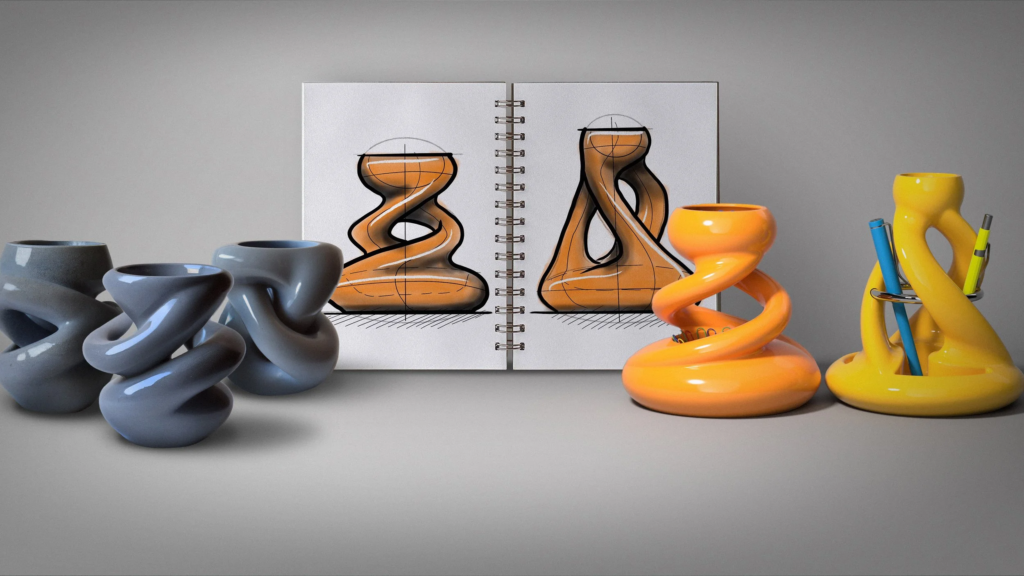
How Designers Should Work in the AI‑Era Product World
In fact, designers in the AI era are no longer just crafting interfaces; rather, they are shaping how learning happens inside products and organizations. Practically, this means working closely with data scientists and engineers—defining what signals matter, how feedback is captured, and how success is measured over time.
On the other hand, designers must become comfortable with uncertainty, since AI behaviors evolve as models and datasets change. Rather than freezing specifications early, teams adopt an iterative loop (research – design – prototype – deploy – learn) that runs continuously. Additionally, AI tools accelerate every step.
Practical Steps to Start Building
Finally, if you want to move an existing product toward AI-Era Product territory, you can follow a sequence of pragmatic steps.
- Map high-value decisions: First, identify where better predictions, recommendations, or automation would create real user or business value—not just novelty.
- Instrument the product: Next, collect the right data with consent and governance in mind, so that models can learn from genuine usage patterns.
- Prototype with AI tools: Then, use modern AI-assisted design and prototyping platforms to experiment quickly with flows, prompts, and adaptive states.
- Pilot and monitor: Ultimately, release limited pilots, measure outcomes, and refine both the UX and the underlying models based on actual behavior.
Therefore, as you refine these cycles, your product gradually evolves from static artifact into adaptive partner—thus fulfilling the promise of the AI-Era Product in a tangible, responsible way.
External reference suggestions for you:
- IBM on AI in product design: https://www.ibm.com/think/topics/ai-product-design
- Neural Concept on AI in industrial design: https://www.neuralconcept.com/post/ai-industrial-design-applications-and-benefits