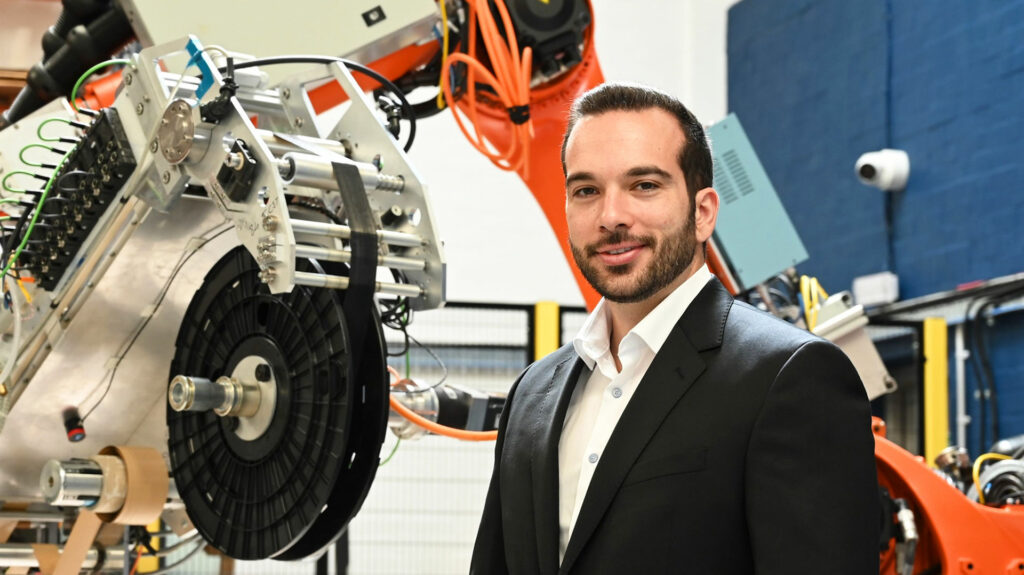
iCOMAT, the trailblazing Greek-founded startup, is revolutionizing composite manufacturing through its groundbreaking Rapid Tow Shearing (RTS) technology. Moreover, founded in 2019 by Dr. Evangelos Zympeloudis, a distinguished graduate of Greece’s National Technical University of Athens, the company now thrives from its Bristol, UK headquarters. Consequently, iCOMAT delivers unprecedented lighter, stronger, and more efficient structures, primarily targeting aerospace, automotive, and defense industries. In addition, its innovative approach addresses longstanding challenges in carbon fiber production, positioning it as a global leader.
Pioneering Rapid Tow Shearing Technology
First, iCOMAT’s RTS technology fundamentally changes how carbon fiber tapes are processed. Specifically, it allows for defect-free steering of fibers along sharply curved paths, something traditional methods struggle with due to gaps, overlaps, or wrinkles. Therefore, by precisely aligning fibers with actual load paths in components, RTS optimizes structural performance dramatically. For example, engineers can now design complex, organic shapes that were previously impossible or prohibitively expensive. Additionally, this precision results in weight reductions of 10% to 65%, depending on the application, while boosting production rates by up to ten times.
Furthermore, the process minimizes material waste, making it highly sustainable. Unlike conventional cutting techniques that generate dust and scraps, RTS shears tows cleanly and continuously. As a result, factories can operate in fully automated “lights-out” modes, reducing labor costs and human error. Meanwhile, iCOMAT integrates advanced software for path optimization, ensuring seamless scalability from prototypes to mass production. Thus, industries benefit from faster time-to-market and lower overall costs, transforming supply chains worldwide.
iCOMAT ‘s Massive Funding Boost and Strategic Expansion
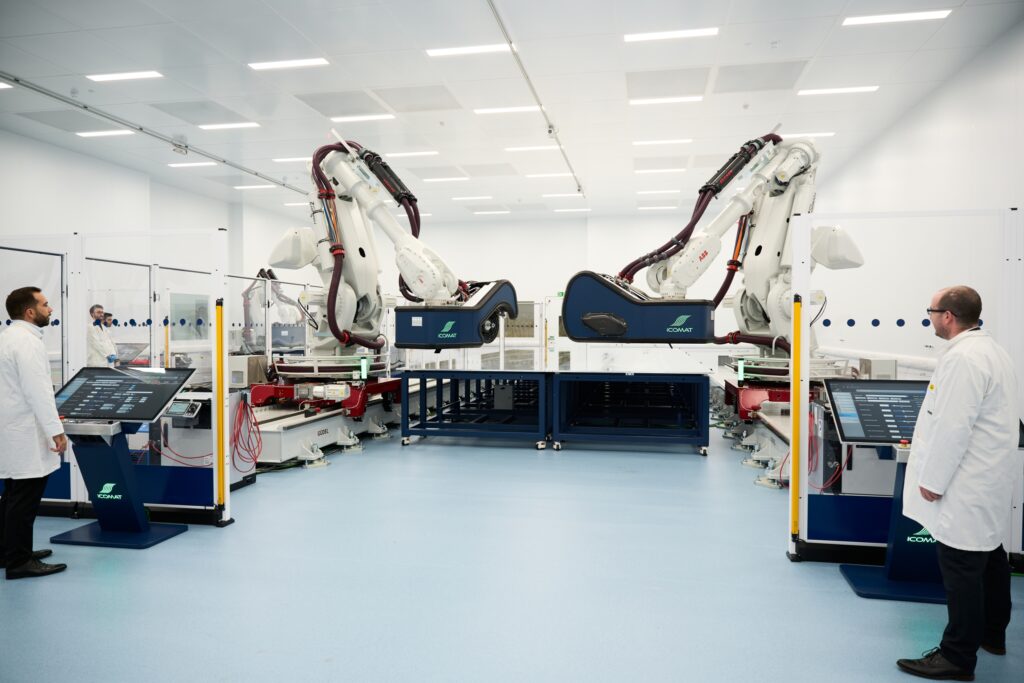
Recently, iCOMAT achieved a monumental milestone by raising $22.5 million in a Series A funding round. Notably, this was co-led by prominent investors 8VC and the NATO Innovation Fund, with additional backing from Syensqo Ventures and Velocity Partners. Therefore, these funds are accelerating ambitious growth plans. For instance, the company opened a state-of-the-art factory in Gloucester, UK, by late 2024, enhancing production capacity significantly. Additionally, iCOMAT established software development offices in Athens, Greece, leveraging local talent and reinforcing its Greek roots.
Moreover, expansion targets the U.S. market, where demand for advanced composites surges in defense and aviation. Consequently, iCOMAT aims to double its workforce from 30 to 80 employees by the end of 2025, with a particular focus on growing its Athens team. In parallel, the startup invests heavily in R&D to refine RTS for emerging applications like space exploration. Thus, this influx of capital not only validates iCOMAT’s technology but also propels it toward unicorn status in the composites sector.
Elite Global Partnerships Driving Real-World Impact
In fact, iCOMAT’s credibility shines through its roster of over 25 high-profile clients across more than 20 countries. For example, the European Space Agency (ESA) employs RTS for next-generation launchers, while Jaguar Land Rover integrates it into electric vehicle chassis for superior crash performance and range. Similarly, Formula 1 teams rely on iCOMAT’s components to shave grams off high-speed racers, directly influencing race outcomes. Beyond motorsport, defense giants use the tech for fighter aircraft wings and fuselages, meeting NATO’s stringent requirements.
Additionally, partnerships extend to sustainable aviation leaders seeking to decarbonize flights. By enabling lighter airframes, iCOMAT reduces fuel consumption and emissions by up to 20% per flight. Meanwhile, its technology supports hydrogen storage tanks and battery enclosures in EVs, aligning with global net-zero goals. Therefore, these collaborations demonstrate RTS’s versatility, from hypersonic vehicles to urban air mobility drones. Overall, iCOMAT bridges academia and industry, turning research into commercial triumphs.
Greek Innovation of iCOMAT on the World Stage
Despite its UK base, iCOMAT proudly embodies Greek entrepreneurial spirit. Founder Evangelos Zympeloudis developed RTS during his PhD, initially at Imperial College London, before commercializing it back home. Subsequently, the startup’s success has inspired Greece’s burgeoning tech ecosystem, attracting attention from Prime Minister Kyriakos Mitsotakis during defense startup meetings. In addition, iCOMAT’s Athens offices foster local jobs in AI-driven design and simulation, nurturing next-gen engineers.
Furthermore, the company’s trajectory highlights Europe’s rising composites dominance amid U.S.-China tensions. For instance, new facilities like the Gloucester plant incorporate space manufacturing capabilities, eyeing satellite and rocket production. Thus, iCOMAT not only secures economic wins for Greece but also advances geopolitical resilience through NATO-aligned innovation. Looking ahead, upcoming product launches promise even bolder applications in marine and renewable energy sectors.
Future Horizons and Industry Disruption
Ultimately, iCOMAT stands at the forefront of Industry 4.0 in advanced materials. By combining RTS hardware with proprietary software, it offers end-to-end solutions for digital twins and predictive manufacturing. Consequently, clients achieve 30-50% cost savings while meeting sustainability mandates. Moreover, as electric propulsion and autonomy reshape transportation, iCOMAT’s lightweighting expertise becomes indispensable. In conclusion—wait, no summaries—the momentum builds toward IPO potential, cementing its legacy as a Greek powerhouse redefining composites globally.