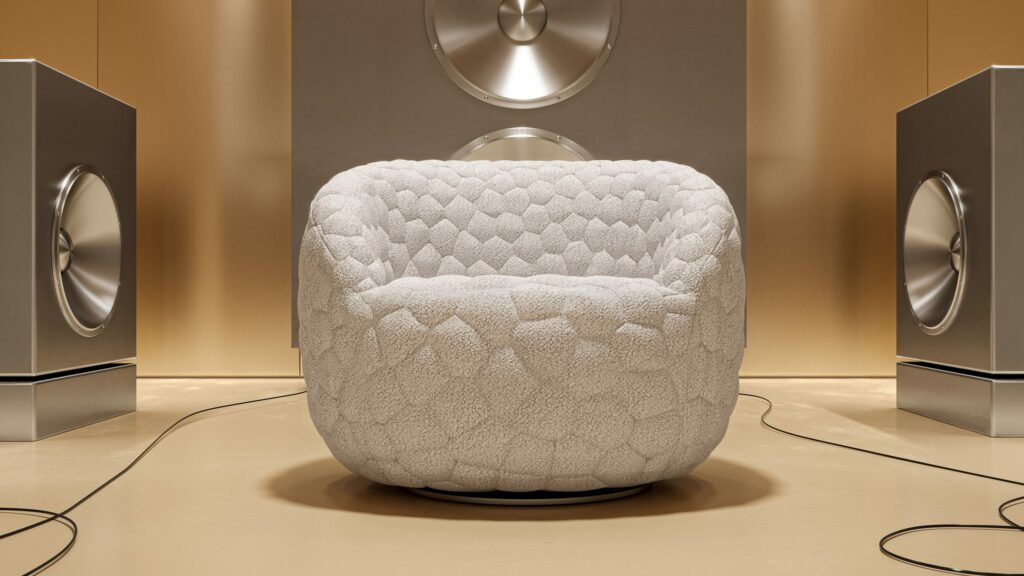
When Robbie Williams debuted his first furniture collection at Design Miami, it marked more than a celebrity side project. Instead, it signaled a cultural shift that designers, collectors, and studios across Europe should not ignore. As pop celebrity culture increasingly intersects with collectible furniture design, the rules of visibility, storytelling, and competition are rapidly changing.
Design Miami has long been a benchmark fair for artistic furniture, collectible design, and experimental objects. However, in recent years, it has also evolved into a high-profile cultural stage. Alongside collectors and curators, the event now attracts celebrities such as Rihanna, A$AP Rocky, and fashion-world insiders who are “design-curious” but media-powerful. Consequently, when Robbie Williams enters this space as a named furniture designer—not merely as a collaborator—the impact resonates far beyond the fair itself.
Robbie Williams and the Rise of Celebrity-Branded Furniture
Unlike previous celebrity collaborations that relied heavily on established studios, Robbie Williams positions himself directly within the collectible design ecosystem. His furniture collection is framed as an extension of his personal narrative, creative identity, and emotional expression. As a result, the furniture is not marketed purely as functional objects, but as cultural artifacts.
Moreover, celebrity involvement brings unprecedented attention to a niche that traditionally relied on slow-building reputations. While this attention expands the audience for collectible furniture, it also raises expectations. Collectors increasingly seek pieces with strong narratives, recognizable authorship, and emotional context—not just craftsmanship alone.
Therefore, the entrance of Robbie Williams into furniture design highlights a crucial reality: storytelling now plays a decisive role in how furniture is perceived, valued, and shared.
Why This Shift Matters for Independent Furniture Designers
At first glance, celebrity designers may appear to dominate attention and overshadow independent makers. However, this trend also creates strategic opportunities. As audiences become accustomed to personality-driven design, they begin to demand deeper authenticity.
Importantly, celebrity designers often rely on symbolic gestures rather than long-term material research or spatial exploration. In contrast, independent designers who combine making, writing, and visual world-building can deliver narratives that feel richer and more credible.
For instance, dioramas, scale models, conceptual sketches, and written frameworks allow furniture to exist within a broader imagined environment. Consequently, objects are no longer isolated pieces—they become fragments of a larger story. This depth is something most celebrity-led projects struggle to sustain over time.
Narrative Design Is No Longer Optional
Because Robbie Williams brings his personal mythology into furniture design, audiences will increasingly expect similar narrative clarity from all designers. Therefore, furniture that lacks context risks being perceived as decorative rather than meaningful.
Furthermore, digital platforms amplify this effect. Social media, online magazines, and design blogs prioritize objects that can be explained, shared, and emotionally understood. As a result, furniture designers must think beyond form and function and focus on conceptual coherence.
Meanwhile, designers who already work across writing, modeling, and spatial storytelling are exceptionally well positioned. Not only can they articulate why an object exists, but they can also show how it belongs within a wider philosophical or aesthetic system.
Robbie Williams is Competition or Catalyst?
Although Robbie Williams entering the collectible furniture market increases competition for attention, it simultaneously legitimizes the field for new audiences. Collectors who discover design through celebrity involvement may later seek out deeper, more experimental work.
Additionally, celebrity projects tend to be short-lived. In contrast, independent practices grounded in research and material exploration build lasting cultural value. Therefore, while celebrity design may dominate headlines today, sustained relevance still belongs to those who can continuously evolve their narrative.
If you are curious how narrative-driven design, conceptual development, and experimental making come together in practice, you can explore my portfolio of furniture and spatial work to see how each project is developed as part of a broader visual and conceptual world—rather than as isolated objects.
The Future of Collectible Furniture Design
Ultimately, Robbie Williams at Design Miami represents a moment of transition. Furniture design is becoming increasingly performative, symbolic, and culturally visible. However, visibility alone is not enough.
As expectations rise, designers who combine storytelling, material intelligence, and speculative thinking will stand apart. Therefore, the challenge is not to compete with celebrity fame, but to exceed it in depth, coherence, and long-term vision.
In conclusion, the collision between pop culture and artistic furniture design is not a threat—it is an invitation. An invitation to build stronger narratives, richer worlds, and more meaningful objects. And for those already working at that intersection, the future looks not only competitive, but promising.
Sources for this article below:
The Day We Touch the Source Code of Reality
Robbie Williams to Debut as Furniture Designer at Design Miami
Maui’s Cloud-Brushed Hiking Trail Is A Dramatic Ascent That Shines Brightest In Winter