Is persona a useful tool to help designers step into other people’s shoes? Or a sort of bizarre fanfiction used to fluff up strategy decks? We speak to designers from both camps.
Studying a persona: “Imagine you own a beachside cafe and you’re trying to get more customers,” strategist Will Poskett wrote recently on LinkedIn. Which of the following would be more useful to know?
Persona One, “Karen is a 38 year old divorced mother of two, from London. She works in finance and her favourite animals are dogs.” Or two, “Karen is on a sweltering hot beach with two grumpy kids, one of whom needs to pee.”
Poskett was using this thought experiment to make the point that “even well-researched” user or audience personas are “a waste of money.”
The post sparked some debate, with people piling into the comments to both defend and hammer a persona. Their use, it seems, really splits opinion.
Everyone agrees that a deep, accurate and nuanced understanding of who you’re designing for is vital to make effective and impactful work.
The question is whether a persona can deliver this understanding. No, says brand and design consultant Bill Wallsgrove, who thinks personas are “just too narrow’ to be useful.
“I think more and more, people are starting to challenge personas.”
He recently rebranded the Barbarians rugby team, and doesn’t see how personas could have helped. “It’s such a wide set of audiences that a persona would trivialise the process,” he says.
“They’ve got the rugby community worldwide – the fans, the players, the clubs, the international teams, the sponsors, the promoters, the merchandise suppliers, the venues. How can any persona capture all of that?”
Wallsgrove says he “doesn’t know any creative designer who’s ever found them useful” and suggests they are often used to “fluff out strategy presentations.”
“The ones I really hate are when they say, ‘He’s a wizard’, or ‘She’s a pathfinder.’ It gets into real Lord of the Rings stuff, which I find a bit laughable. But then I am an old cynic.”
Wallsgrove draws parallels with the classification of consumers into groups like ABC1. This system was developed by the National Readership Survey (NRS) in the 1950s. Although based on people’s occupation and education, it became widely used to extrapolate each group’s potential spending power.
“The idea of ABC1 is way out of fashion now,” Wallsgrove says. “And I think more and more, people are starting to challenge personas too.”

User personas as we understand them today were invented by software designer Alan Cooper in 1985. To help him create a new project management tool, he interviewed a group of users to understand how they wanted and needed to use the programme.
Cooper combined their insights and opinions into a composite fictional user, Kathy (named after one of the real interviewees), and the user persona was born.
Writing in his book, The Inmates are Running the Asylum: Why High-Tech Products Drive Us Crazy and How to Restore the Sanity, Cooper defined his invention.
“Personas are not real people, but they represent them through the design process. They are hypothetical archetypes of actual users. Although they are imaginary, they are defined with significant rigor and precision.”
For Cooper, personas unlock empathy – they allow designers to step into someone else’s shoes. This helps them not only understand how people might experience a product or service, but predict how their future needs might change.
Roger How of How&How very much sees personas in this way.
“The audience of any brand work is the hero of the story,” he explains. “Personas put some guardrails down and give us a clearer picture of who we’re talking to. Likewise, consumers have different things they want to get out of a brand, and we can only really define those things if we define that person.”
How&How doesn’t create personas in the form of a named character with a set of characteristics and a backstory. Instead, the team uses quantitative data and qualitative anecdotes to create groups of people with whom the brand wants to engage.
These can be very broad, or very specific, as in B2B projects, where the group might be “procurement officers at nature-based carbon credit companies.”
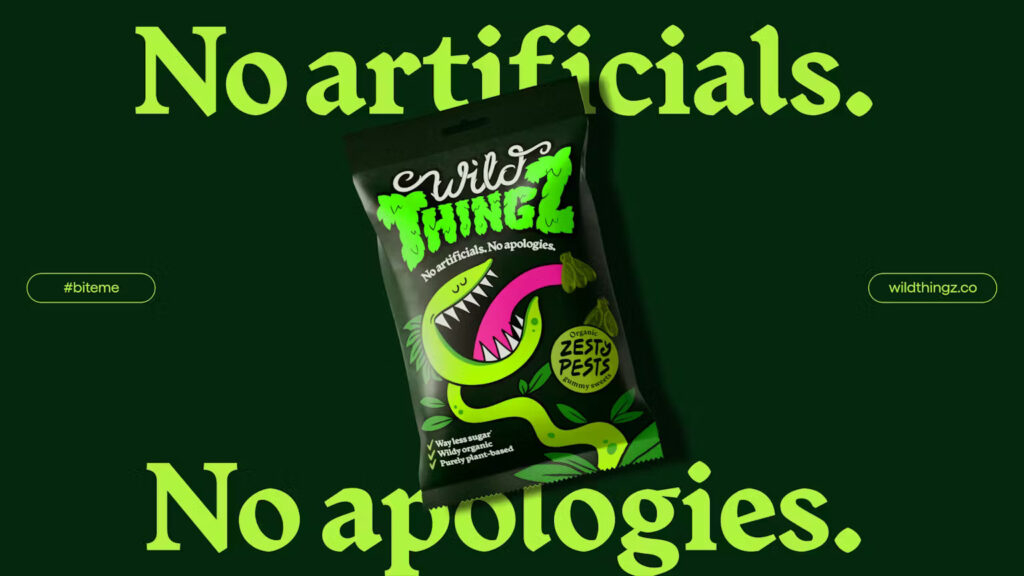
For its recent work on healthy sweets brand Wild Thingz, the How&How team honed in on two personas. One they called The Reluctants, parents who don’t really want to buy their children sweets, but don’t want to be puritanical killjoys either. The other group was, “kids who like sweets, which is all kids basically.”
The visual approach they settled on came from looking at the intersection between the two categories.
“The great thing about personas is that if they’re very clear, and they’re very different, you can get this amazing smash in the middle,” explains his co-CEO, Cat How.
“We know kids like stuff that’s fun and engaging, and that looks really bad for you,” she says. “And we know parents are reluctant to buy their kids sweets.
“So if we combined the desires that the kids have, with the desires their parents have, organic with punk, then we could create a really interesting fusion. That’s why we made a brand that looks like Cabbage Patch dolls crossed with Santa Cruz skateboards.”
In view of this, this idea of personas pushing designers into new creative territory is echoed by Paul Silcox, the executive creative director of brand experience at FutureBrand.
“They help stretch our thinking,” he says. “They allow us to find meaningful and relevant opportunities for brands to be useful and emotionally resonant in the lives of audiences.”
Notwithstanding, for critics, personas can resemble a sort of bizarre fan fiction, where random details are layered on top of basic age-sex-location information.
But to be useful, Silcox insists personas need to go beyond the obvious, to create, “a factual and emotional journey map.”
“The personas we create are detailed and robust, focusing on the real lives of the desired core audience types,” he explains.
“We build characters who have rich, deep detail around where they live, how old they are, their lifestyle today and their backstory. Furthermore, it’s also important to include their emotional goals and to define their priorities, in both the short and long term.”
For each project, FutureBrand typically uses customer segmentation, data, and user interviews to build a few key personas.
So for its recent work for Air India, the team honed in on large families and solo elderly travellers who together make up a large part of the airline’s customer base.
Building on these personas, they could identify different parts of the experience – before, during and after the flight – that could be tailored to their specific needs.
Both those who value personas as a design tool, and those who don’t, agree that it’s vital to get into people’s heads.
“The whole point of any brand design is to make sure you’re getting your message out, your promise and your purpose, to the right people in the right place. Hence, knowing who those people are, what motivates them, and where they gather, is critical,” Bill Wallsgrove says. “Nobody would deny that. But I would never put that into a persona.”
Sheffield agency Peter & Paul uses barriers as a way in. “We find traditional personas a bit limiting,” says creative director Lee Davies.
“Our approach is less demographic and more psychographic,” he explains, focusing on common emotional obstacles that stop “a whole range of people of all ages and backgrounds” engaging with a product, service or event.
Therefore, Davies cites their identity for the Leeds Year of Culture as an example.
“In Leeds, we knew from research that people saw culture as elitist and inaccessible. So that was our ‘barrier’, and that was true of young, old and everything in between, so no personas needed.
“Connecting this insight with what the client was offering, what they were competing against, and how that would land in the context of Leeds, gave us the brand positioning idea and the visual delivery that sprang from it – Letting Culture Loose.”
Actually how personas evolve may be influenced by technology. Futurebrand’s Paul Silcox points out that personas are useful when budgets are too tight for “extensive qualitative testing.” Accordingly, in this context, he says, “personas provide an efficient alternative, offering guidance that keeps the work grounded in real audience needs.”
But many people in the research space are excited by the rise of synthetic data. This uses AI to create and survey imaginary customers and, apparently, creates highly accurate insights much more quickly and cheaply.
Against this backdrop, it will be interesting to see if personas still have a role to play in the design process.
Original Article by Rob Alderson